
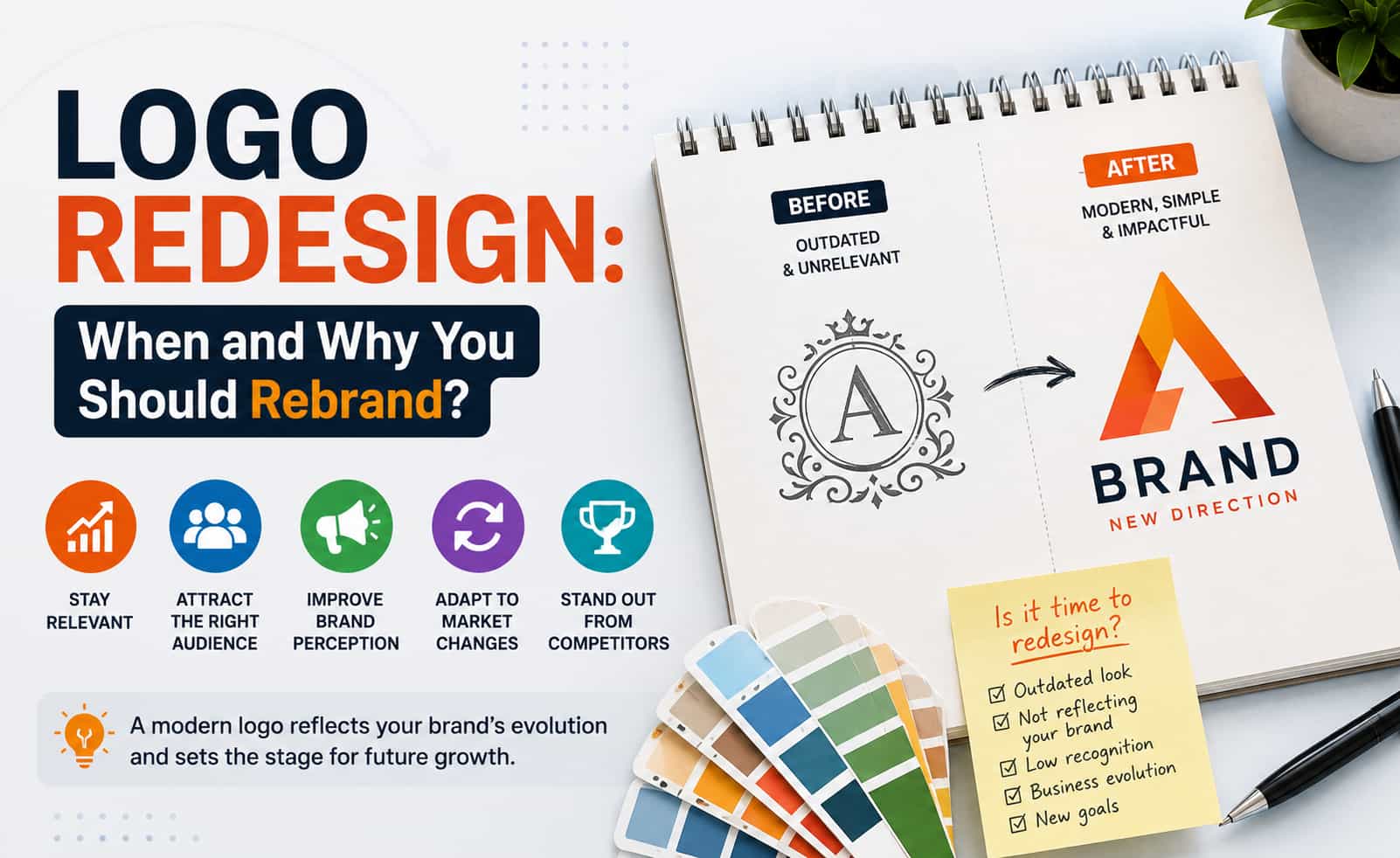
You should redesign a logo when the existing identity no longer supports the business’s strategy, audience, positioning, or real-world applications. A refresh may be enough when the core identity still works but needs refinement. A broader rebrand is appropriate when the underlying positioning or business itself has changed. And if there’s no meaningful strategic problem, keeping the existing logo may be the smartest decision you make this year.
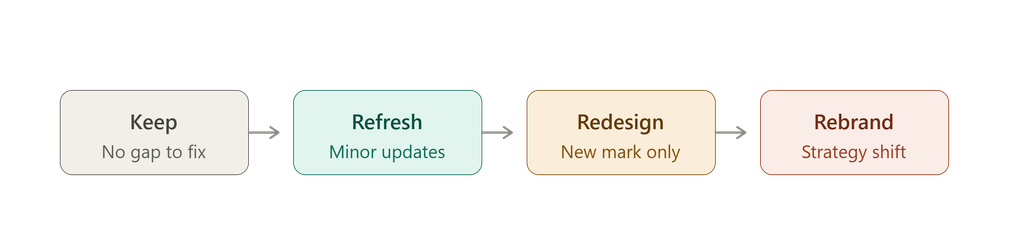
That’s the uncomfortable truth most branding content won’t tell you: not every business that’s “tired of its logo” actually needs a new one. This guide gives you a practical framework — Keep → Refresh → Redesign → Rebrand — so you can make a decision based on evidence, not boredom.
How Do You Know If It’s Time to Redesign Your Logo?
Direct answer: It’s time to redesign your logo when it no longer represents what your business actually does, fails across modern digital applications, or actively works against your positioning in the market. It is not time to redesign simply because leadership is bored with how it looks.
Start With Strategy, Not Aesthetics
“I don’t like our logo anymore” is a feeling, not evidence. Before anyone touches a design file, the real question is whether the identity still communicates the right thing to the right audience. A logo that’s aesthetically dated but strategically accurate is a very different problem than a logo that’s stylish but misrepresents the business. Only one of those is a design problem — the other is a strategy problem, and no amount of new typography fixes it.
This is one of the most common misdiagnoses we see. A company that has quietly pivoted its offering, moved upmarket, or found a new core audience will often blame the logo for a disconnect that’s actually rooted in positioning. If your logo design brief can’t clearly answer “what does this business do differently now than it did when this logo was created,” that’s the real signal worth investigating first.
Ask Whether the Logo Still Represents the Business
Run this check against five dimensions:
- Business evolution — has your product, service, or business model materially changed?
- Positioning — do you compete on the same value proposition you did when the logo launched?
- Products/services — does your current offering match what the identity implies?
- Market perception — do customers describe you the way you’d want to be described?
- Brand promise — does the logo still visually deliver on what you promise customers?
If most of these have shifted, the logo is likely a symptom of a larger positioning gap rather than the root cause.
Test Whether the Logo Works Across Modern Touchpoints
A surprising number of “outdated” logos are actually just poorly adapted logos. Before assuming you need a redesign, test the current mark across every environment where customers actually encounter it:
- Website header and mobile navigation
- Social profile avatars
- App icons and favicons
- Digital ads and email signatures
- Packaging and product labeling
- Print collateral and signage
- Video intros and motion contexts
- Small-format applications (business cards, badges, merchandise)
If the logo performs well strategically but breaks down technically — pixelating at small sizes, losing legibility as a favicon, or failing on product packaging — that’s a strong signal you need a redesign focused on scalability and system-building, not a full rebrand.
What Are the Signs That It’s Time to Rebrand?
Direct answer: The clearest signs it’s time to rebrand include business growth beyond the original positioning, a fundamental audience shift, a company pivot, a merger or acquisition, inconsistent branding across products or teams, and a visual identity that no longer scales across digital environments.
1. The Business Has Outgrown Its Original Positioning
Many logos are designed for the company a founder started, not the company that exists three or five years later. If your original identity was built around a narrow product line, a local market, or a specific customer type you’ve since outgrown, the mark is now working against you rather than for you.
Evidence to collect: Compare your original positioning statement to your current one. If they no longer match, the logo is likely carrying strategic weight it was never designed to hold.
2. Your Target Audience Has Changed
A logo designed to appeal to one demographic can feel actively off-putting to another. A B2C brand moving into enterprise B2B, or a budget-tier company moving upmarket, often finds that the visual language — not just the messaging — no longer resonates.
3. The Company Has Pivoted
A genuine business-model pivot (new category, new revenue model, new core product) is one of the strongest legitimate triggers for a full identity change, because the logo is now describing a business that technically no longer exists in that form.
4. Your Visual Identity No Longer Matches Your Market Position
If competitors and customers perceive you as a premium, modern, or category-leading player, but your identity still reads as budget, generic, or dated, there’s a mismatch between market reality and visual signaling.
5. The Brand Looks Significantly Less Relevant Than Competitors
This one requires caution. “Our competitor just rebranded and looks fresher” is not, by itself, sufficient justification — see the section below on when not to rebrand. But if an entire category has visually matured and your identity now reads as noticeably behind rather than simply “classic,” it’s worth a genuine audit.
6. The Logo Doesn’t Scale Well Digitally
Marks designed before mobile-first, app-icon, and social-avatar contexts existed frequently fail in these formats. Fine detail, thin linework, and long horizontal lockups often break down at 32×32 pixels. This is a design and system problem, and it’s one of the most common — and most fixable — reasons for a redesign.
7. Multiple Products or Teams Use Inconsistent Branding
If different departments, regions, or product lines have quietly drifted into using different logo versions, colors, or lockups, that’s a brand-governance failure as much as a design one. It signals the need for a cohesive identity system, guided by clear logo design standards, rather than a wholesale creative reinvention.
8. A Merger or Acquisition Has Changed the Brand Architecture
When two companies combine, the resulting entity often needs a new mark that reflects the combined positioning — or a clear decision about which brand survives and how the other is retired or folded in.
9. The Brand Has a Reputation or Perception Problem
This is the trickiest trigger. A logo change alone rarely repairs a genuine trust or reputation issue, and treating a redesign as reputation management can backfire if customers perceive it as a distraction rather than a fix. Address the underlying issue first; consider the visual refresh as one part of a larger recovery, not a substitute for it.
10. The Current Identity Creates Strategic Limitations
If the existing name, mark, or system actively prevents expansion — a name too narrow for a broader product line, a mark that can’t be trademarked in a new market, a system that can’t flex across new product categories — that’s a structural limitation, not a cosmetic one.
Should You Refresh Your Logo, Redesign It, or Rebrand the Whole Business?
Direct answer: A refresh is a minor visual evolution (typography, color, spacing) that preserves brand equity. A logo redesign is a more significant structural change to the mark itself, often to fix scalability or relevance, while broader positioning stays intact. A full rebrand touches positioning, messaging, and sometimes naming — it’s a strategic transformation, not just a visual one.
What Is a Logo Refresh?
A refresh evolves the existing identity without discarding what customers already recognize. Typical refresh work includes typography updates, color refinement, spacing and proportion adjustments, simplification of overly complex marks, and building out responsive variations for digital use. Nike, Google, and countless legacy brands have refreshed repeatedly over decades without ever fully rebranding — because the underlying equity was still working hard for them.
What Is a Logo Redesign?
A redesign is a more substantial change to the mark itself — a new symbol, a restructured wordmark, or a rebuilt visual system — while the underlying brand strategy and positioning remain valid. This is the right move when the design is the limiting factor: it doesn’t scale, it doesn’t differentiate, or it doesn’t reflect the business accurately, but the strategy underneath it is still sound.
What Is a Full Rebrand?
A full rebrand is a strategic transformation that can touch positioning, messaging, brand strategy, naming, visual identity, brand architecture, and customer experience simultaneously. It’s appropriate when the business itself — not just its appearance — has fundamentally changed. This is the highest-risk, highest-cost option, and it should be reserved for genuine strategic inflection points.
What Is the Difference Between a Refresh, Redesign, and Rebrand?
| Situation | Do Nothing | Refresh | Logo Redesign | Full Rebrand |
|---|---|---|---|---|
| Logo still strategically fits | ✓ | |||
| Minor visual issues | ✓ | |||
| Major visual/scalability limitations | ✓ | |||
| Business positioning has changed | ✓ | ✓ | ||
| Audience has fundamentally changed | ✓ | |||
| Merger or acquisition | Possible | ✓ | ||
| Major reputation problem | Possible | ✓ | ||
| Brand strategy remains valid | ✓ | ✓ | ✓ | |
| Brand strategy itself has changed | ✓ |
Strategic Insight: A logo redesign should solve a business or brand problem — not simply satisfy an internal preference. If you can’t articulate the business problem a new logo solves, you’re not ready to commission one.
When Should You NOT Redesign Your Logo?
This is the section most branding content skips, because agencies don’t get paid for telling you to keep what you have. But knowing when not to change is just as valuable as knowing when to change.
You Are Simply Bored With It
Internal fatigue is real — you look at your logo every single day. Your customers don’t. Familiarity to you does not mean irrelevance to them.
The Logo Is Still Recognizable and Effective
If customers recognize it instantly, associate it with trust, and it performs across your applications, you have brand equity that took years to build. Don’t discard it to solve a problem it isn’t causing.
A Competitor Recently Changed Its Logo
Reactive rebranding — changing your identity because someone else changed theirs — is rarely strategically sound. It’s driven by anxiety, not evidence, and it can make your brand look like it’s following rather than leading.
You Are Chasing a Temporary Design Trend
Gradient logos, flat design, hand-drawn wordmarks — every design era has a trend cycle. A logo built to chase 2026’s aesthetic will look dated again by 2029. Timeless, flexible systems age better than trend-driven ones.
The Real Problem Is Your Messaging
If customers misunderstand what you do or why you’re different, that’s frequently a messaging and positioning issue, not a visual one. A new logo on top of unclear messaging just gives the confusion a fresh coat of paint.
The Real Problem Is Your Customer Experience
A poor product experience, weak service, or unresolved reputation issue won’t be fixed by a new mark. In fact, as covered in our piece on how logo design can bring down your business, a redesign that isn’t backed by real operational change can actively damage trust — it signals change without delivering it.
There Is No Strategic Business Trigger
If you can’t point to a specific business event — growth, pivot, merger, audience shift, or a documented usability failure — that’s a sign you’re solving for preference, not strategy.
The Business Cannot Support a Proper Rollout
A redesign that isn’t fully rolled out — old and new marks living side by side across channels for months or years — creates more brand confusion than the outdated logo ever did. If you don’t have the resources for a coordinated rollout, wait until you do.
If the only argument for redesign is that leadership personally dislikes the logo, pause before changing it.
What Business Changes Should Trigger a Logo Redesign?
Rather than a vague feeling that “it’s time,” look for one of these concrete triggers:
- Rapid business growth that has outpaced the original brand’s scope
- Entering new markets where the existing identity doesn’t translate culturally or competitively
- Changing the target audience — moving from consumer to enterprise, budget to premium, or niche to mainstream
- Launching a new product category that the current brand architecture can’t accommodate
- A business pivot into a materially different model or offering
- Merger or acquisition requiring a unified or newly negotiated identity
- New ownership or leadership with a distinct strategic direction
- Repositioning against competitors after a shift in the competitive landscape
- Moving from startup to established brand, where a scrappy identity no longer signals stability
- Digital transformation, where legacy identity assets weren’t built for modern application requirements
Each of these represents a business event first. The logo change is a downstream consequence, not the starting point.
How Does Digital Transformation Change Logo Design Requirements?
Many logos that feel “outdated” were never actually designed poorly — they were designed for a print-and-signage world that no longer reflects how customers encounter brands today. Before commissioning a full redesign, run the identity through this test:
- Does your logo work at small sizes? Fine detail and thin strokes often disappear below 100px.
- Does it work as a social avatar? Long horizontal lockups get awkwardly cropped into squares and circles.
- Does it work as a favicon or app icon? This is the smallest, highest-frequency application your logo will ever face.
- Does it need responsive variations? Modern identity systems typically include a primary mark, a compact mark, and an icon-only mark.
- Does the identity work across light and dark interfaces? Dark-mode UI has made reversed/contrast versions a near-requirement.
- Can the logo be used consistently across digital products? Inconsistent applications across apps, dashboards, and marketing sites erode trust.
Version / Environment Matrix
| Environment | Required Logo Test |
|---|---|
| Website header | Horizontal/primary mark |
| Mobile navigation | Compact mark |
| Favicon | Extremely small-scale recognition |
| Social avatar | Square/circular context |
| App icon | Standalone symbol |
| Dark UI | Contrast/reversed version |
| High-resolution master file | |
| Packaging | Production and material constraints |
| Video/motion | Animation compatibility |
If your logo fails several of these tests but still fits your strategy, the fix is a redesign for system-building, not a full rebrand.
How Often Should You Redesign Your Logo?
Direct answer: There is no universal redesign schedule. Rather than following a fixed number of years, base the decision on strategic relevance, audience shifts, market conditions, and evidence that the current identity is limiting the business. An annual brand-health review, not a countdown clock, is the healthier approach.
Why There Is No Universal Rebranding Schedule
You’ll see “every 7–10 years” cited across branding content, but this figure isn’t a scientific standard — it’s an informal industry observation, and real-world examples contradict it in both directions. Some brands (Coca-Cola, Wells Fargo) have run largely unchanged logos for decades. Others have refreshed multiple times within a single decade in response to specific business changes. Treat any fixed-year rule as a rough heuristic at best, not a deadline to plan around.
What Matters More Than the Number of Years
- Strategic relevance to your current business
- Audience changes since the last update
- Market and competitive conditions
- The health of your existing brand equity
- New technology and application requirements
- Business evolution and growth stage
- Competitive differentiation
What Should You Review Annually?
An annual brand-health check — not a redesign — should assess recognition, consistency across touchpoints, and whether the identity still reflects current positioning. This keeps you ahead of problems without triggering unnecessary change.
What Should Trigger a Formal Redesign Evaluation?
Use the trigger list above (growth, pivot, merger, audience shift, digital failure) rather than a calendar. A trigger-based approach protects brand equity while still catching genuine strategic drift.
How Can You Decide Whether a Logo Redesign Is Worth the Risk?
Assess Existing Brand Equity
Before changing anything, honestly evaluate what you already have: recognition, recall, customer familiarity, distinctive visual assets (a color, shape, or symbol customers associate with you), and any historical or emotional associations tied to the current mark. The stronger this equity, the higher the bar should be for change.
Measure the Cost of Keeping the Existing Identity
Ask directly: Does it confuse customers? Does it limit digital use? Does it undermine your current positioning? Does it create inconsistency across teams or products? Does it make expansion into new markets harder? If the honest answer to most of these is “no,” inaction may be the lower-risk choice.
Compare the Cost of Change With the Cost of Inaction
Build a simple two-column model. On one side: rollout costs, potential recognition loss, internal disruption, and design/development time. On the other: the ongoing cost of confusion, inconsistency, or a mismatch between how you look and how you actually operate. The stronger and more specific the second column, the more justified the redesign.
Identify What Could Be Lost
- Recognition built over years
- Customer familiarity and trust
- Distinctive visual assets
- Internal and operational consistency
Identify What Could Be Gained
- Better strategic positioning
- Improved real-world usability
- Stronger audience fit
- Clearer differentiation from competitors
- Greater scalability across digital environments
- More consistent brand application
What Should You Do Before Starting a Logo Redesign?
Audit the Existing Brand
Catalog every current asset, application, and inconsistency before you start designing anything new.
Review Customer Perception
Talk to real customers about how they currently perceive your brand — don’t rely solely on internal opinion.
Review Competitors
Understand the current visual landscape in your category so the new identity differentiates rather than blends in.
Define the Business Objective
Write down, in one sentence, the specific business problem the redesign is meant to solve.
Identify What Brand Equity Must Be Preserved
Decide upfront which colors, shapes, or associations are too valuable to lose in the process.
Audit Every Existing Brand Touchpoint
List every place the current logo appears — digital, print, packaging, signage, merchandise — so the rollout plan is complete from day one.
Align Internal Stakeholders
Get leadership, marketing, product, and sales aligned on the objective before creative work begins, not after.
Define Success Metrics
Decide in advance how you’ll know the redesign worked, so you’re not retrofitting justification later.
Decide the Scope
Confirm whether you’re commissioning a refresh, a redesign, or a full rebrand — each has a different scope, budget, and rollout plan. A clear, well-structured logo design brief is the single best tool for locking this scope in before creative work starts.
Pre-Redesign Checklist
- Business reason documented
- Target audience defined
- Positioning reviewed
- Existing equity identified
- Competitive landscape reviewed
- Digital applications audited
- Stakeholders aligned
- Scope agreed
- Success metrics established
- Rollout requirements identified
Not sure which level of change you need? Start with a brand audit before commissioning a redesign.
What Is the Logo Redesign Process?
- Define the business problem the redesign needs to solve.
- Conduct brand and audience research to ground decisions in evidence.
- Audit existing brand equity to identify what must be preserved.
- Establish strategic direction before any visual exploration begins.
- Develop creative territories — broad conceptual directions, not finished logos.
- Explore logo concepts within the approved territories.
- Test concepts in real applications — favicon, mobile, packaging, signage — not just presentation slides.
- Select and refine the identity based on testing feedback.
- Build the brand system — color, typography, spacing, and usage rules.
- Create brand guidelines so the system is applied consistently going forward.
- Plan the rollout across every touchpoint identified in the audit.
- Measure results against the success metrics defined at the outset.
Use your current brand assets to assess where the real problem lies before deciding on scope.
What Are the Most Common Logo Redesign Mistakes?
- Redesigning without a business objective — change for the sake of change.
- Choosing what executives like instead of what customers need.
- Chasing trends that will look dated within a few years.
- Changing too much at once, discarding equity unnecessarily.
- Ignoring existing brand equity built over years of consistent use.
- Designing only for a presentation mockup, not real-world conditions.
- Forgetting small-screen applications — favicons, app icons, avatars.
- Failing to build a complete identity system, leaving teams to improvise.
- Launching without an internal rollout plan, causing inconsistent adoption.
- Claiming ROI without measurement — assuming success rather than proving it.
How Do You Know If the Problem Is Your Logo or Your Brand?
This diagnostic table is one of the most useful tools in this entire guide — it prevents you from treating every branding symptom as a logo problem.
| Problem | Likely Cause | First Action |
|---|---|---|
| Customers don’t understand the offer | Messaging/positioning | Review positioning |
| Logo looks inconsistent across channels | Brand system/governance | Audit identity system |
| Logo is unreadable on small screens | Logo design | Redesign or refine the mark |
| Customers no longer recognize the company | Positioning/brand architecture | Research before redesigning |
| Brand feels outdated | Could be identity or strategy | Conduct a full brand audit |
| Competitors look more distinctive | Differentiation | Review positioning + identity together |
| Negative customer perception | Reputation/customer experience | Fix the underlying issue first |
If you consistently see “messaging,” “customer experience,” or “reputation” as the likely cause, redesigning the logo alone won’t move the needle — and understanding this distinction is central to why logo design genuinely drives business growth only when it’s paired with the right underlying strategy.
What Are the Biggest Risks of Changing a Logo?
| Risk | Mitigation |
|---|---|
| Loss of recognition | Preserve at least one distinctive equity element (color, shape, or symbol) |
| Customer confusion | Run a clear, well-communicated transition period |
| Internal resistance | Align stakeholders early with a documented business case |
| Rollout costs | Scope the rollout budget before committing to the redesign |
| Inconsistent implementation | Build comprehensive brand guidelines before launch |
| Losing valuable brand assets | Audit equity thoroughly before design begins |
| Strategic mismatch | Anchor every design decision to the defined business objective |
| Negative customer reaction | Test concepts with real customers before full rollout |
What Makes a Successful Logo Redesign?
A redesign earns its cost when it:
- Solves a real, documented business problem
- Preserves the brand equity that’s genuinely worth keeping
- Improves real-world usability across digital and physical applications
- Fits the actual target audience, not just internal taste
- Meaningfully differentiates the brand from competitors
- Functions as a complete system, not just a single mark
- Ships with a clear implementation and rollout plan
- Has success criteria that can actually be measured after launch
How Should You Measure a Logo Redesign After Launch?
- Brand recognition — do customers identify you correctly post-launch?
- Brand recall — can customers describe or recall the mark unprompted?
- Customer perception — has sentiment shifted in the intended direction?
- Digital engagement — any measurable change in click-through or interaction patterns tied to the new identity?
- Conversion/business metrics — tracked carefully, and only where a credible causal link exists.
- Brand consistency — is the new system being applied correctly across every channel?
- Internal adoption — are teams actually using the new guidelines?
Be cautious about attributing revenue or traffic growth directly to a logo change. Brand and business metrics should be tracked separately, since dozens of other variables typically move at the same time as a rebrand.
What Should Your Logo Redesign Decision Be?
Keep the Existing Logo If…
Your strategy, audience, and positioning are all still accurate, and the logo performs well across current applications.
Refresh the Logo If…
The core identity is still strategically sound but needs modernized typography, color, or digital variations.
Redesign the Logo If…
The strategy is intact, but the mark itself has real usability, scalability, or differentiation problems.
Rebrand the Business If…
Positioning, audience, or the business model itself has fundamentally changed.
Stop and Investigate Further If…
You can’t clearly identify the business problem, or the issue seems to be messaging, experience, or reputation rather than the visual identity itself.
Decision Tree
1. Does the current brand strategy still fit the business? → No → Evaluate a broader rebrand → Yes → Continue
2. Does the current logo accurately represent the brand? → No → Evaluate redesign or refresh → Yes → Continue
3. Does the logo work across required applications? → No → Evaluate redesign/refinement for scalability → Yes → Continue
4. Is there a measurable business or audience problem? → No → Keep the existing identity → Yes → Validate scope before making any change
If the audit shows a genuine identity gap, the next step is to define the redesign brief.
FAQs
When should a company redesign its logo?
When the current mark no longer supports the business’s strategy, audience, or real-world application needs — not simply because it looks old.
How often should a company redesign its logo?
There’s no fixed schedule. Base the decision on strategic triggers (growth, pivot, merger, audience shift) rather than a calendar, and review brand health annually.
What are the biggest signs that a logo needs to change?
Business growth beyond original positioning, a changed target audience, a company pivot, poor digital scalability, and inconsistent branding across teams or products.
What is the difference between a logo refresh and a logo redesign?
A refresh makes minor visual updates (typography, color, spacing) while preserving equity. A redesign makes more substantial changes to the mark itself while the underlying strategy stays the same.
What is the difference between a logo redesign and a full rebrand?
A redesign changes the visual mark. A rebrand changes the underlying strategy — positioning, messaging, sometimes naming — with the visual identity updated to match.
Can redesigning a logo hurt brand recognition?
Yes, especially if the change is abrupt, discards all existing equity, or isn’t supported by a proper rollout plan. Preserving at least one recognizable element reduces this risk.
Should a company redesign its logo after a merger?
Often yes, since a merger changes the brand architecture and may combine two audiences, positioning strategies, or legacy identities that need to be reconciled.
Should a startup redesign its logo as it grows?
Frequently — a scrappy early-stage mark often needs to evolve as the company moves from startup to an established, more mature market position.
Should you redesign a logo just because it looks outdated?
Not by itself. “Looks outdated” is worth investigating, but it should be paired with a genuine strategic or usability trigger before you commit to a redesign.
When should you not redesign your logo?
When the only motivation is internal boredom, a competitor’s recent rebrand, a design trend, or an underlying issue that’s actually about messaging or customer experience rather than the mark itself.
How much does a logo redesign cost?
Costs vary significantly based on scope — a refresh, a redesign, or a full rebrand each carry very different budgets, and pricing should be scoped against your specific business objective rather than a generic industry figure.
How long does a logo redesign take?
Timelines depend on scope, but a proper process — research, strategy, exploration, testing, system-building, and rollout — typically spans several weeks to a few months for a well-executed redesign.
What should a company do before redesigning its logo?
Audit the existing brand, review customer perception and competitors, define the business objective, identify equity to preserve, align stakeholders, and set measurable success criteria.
How do you measure whether a logo redesign worked?
Track brand recognition, recall, customer perception, consistency of application, and internal adoption — while treating broader business metrics like revenue as separate, multi-factor outcomes.
Can a logo redesign fix a weak brand?
No — a logo redesign fixes visual and usability problems. Weak positioning, unclear messaging, or poor customer experience require strategic and operational fixes, not just a new mark.
The Bottom Line
A logo should change because the business, audience, positioning, or application requirements have changed — not simply because the logo feels old. Run your situation through the Keep → Refresh → Redesign → Rebrand framework, be honest about which category you’re actually in, and only invest in change once you can point to a real business reason behind it.
Need an objective assessment of your current brand identity? If this framework has surfaced a genuine gap between your business and your current mark, the next step is a professional logo design consultation to scope the right level of change — refresh, redesign, or full rebrand — based on your specific business objective.
Leave a Reply