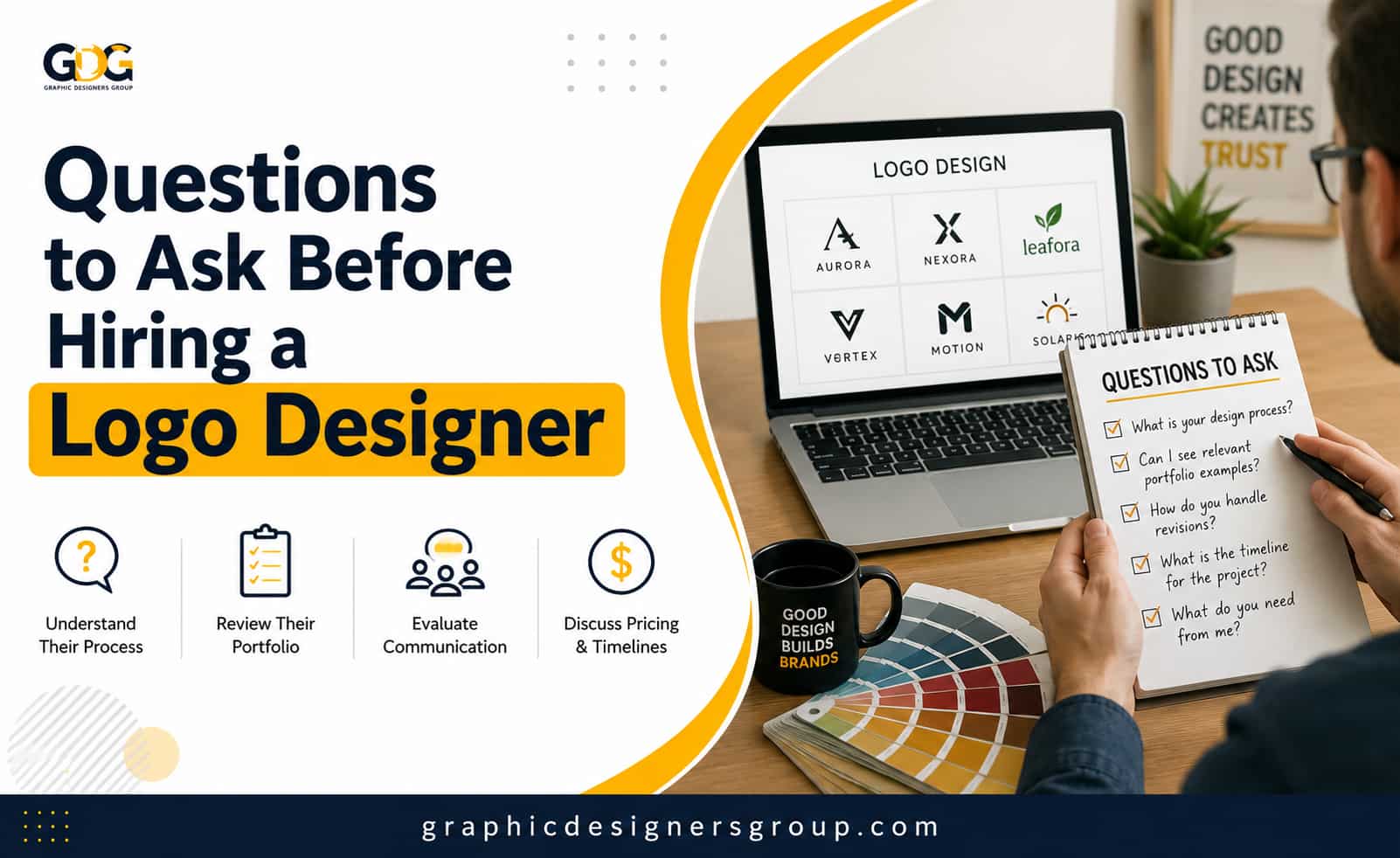
Before you pay a deposit, you have leverage. After you pay it, you’re negotiating from the back foot. That single fact is why the questions you ask during the first conversation with a logo designer matter more than almost anything else in the entire hiring process — more than the price on their website, more than how polished their portfolio looks, more than how quickly they respond to your first email.
Most first-time buyers don’t lose money on logo design because they hired an untalented designer. They lose money — and time, and brand equity — because they never asked who would legally own the finished logo, what counted as a “revision,” or what file formats were actually included. Those aren’t awkward questions. They’re standard business due diligence, and any designer worth hiring will answer them without hesitation.
This article organizes the questions you need into six categories: process, pricing and contracts, ownership and usage rights, communication and timelines, files and deliverables, and experience/fit. For each question, you’ll get why it matters, what a good answer sounds like, and what a red-flag answer sounds like. Work through all six categories with every designer you’re seriously considering — not just the pricing section — because the mistakes that hurt buyers most tend to hide in the categories people skip.
How to Use This List
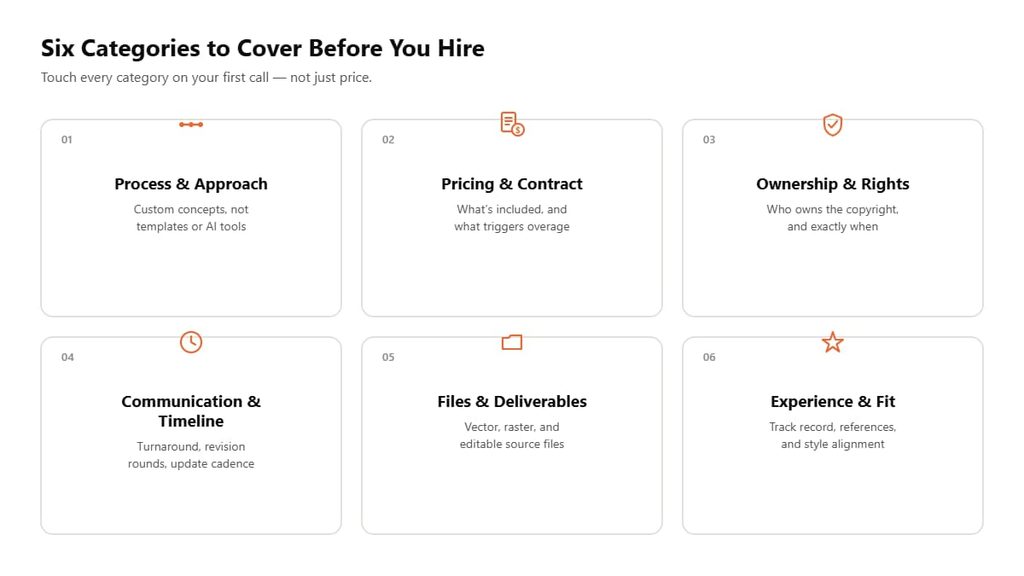
Treat your first call or email exchange with a prospective designer like a structured interview, not a casual chat. You don’t need to ask every single question below verbatim, but you should touch every category before you commit money. A designer who handles the process and pricing questions smoothly but gets vague or defensive on ownership questions has just told you something important — pay attention to where the hesitation shows up, not just to whether they eventually give an answer.
If you haven’t yet put your own requirements in writing, do that first — it will make every question below sharper and easier to ask, since you’ll be comparing the designer’s answers against a concrete brief rather than a vague idea in your head. A well-prepared logo design brief also filters out designers who can’t work from a real brief and only want to riff on inspiration boards.
Category 1: Process and Approach Questions
These questions tell you whether you’re hiring a designer who actually designs, or someone assembling pre-made elements and calling it custom work. This distinction matters enormously — a templated or AI-generated mark can look fine in a thumbnail and still fail the moment you need it resized, trademarked, or extended into a broader identity system.
“Walk me through your process from start to finish.”
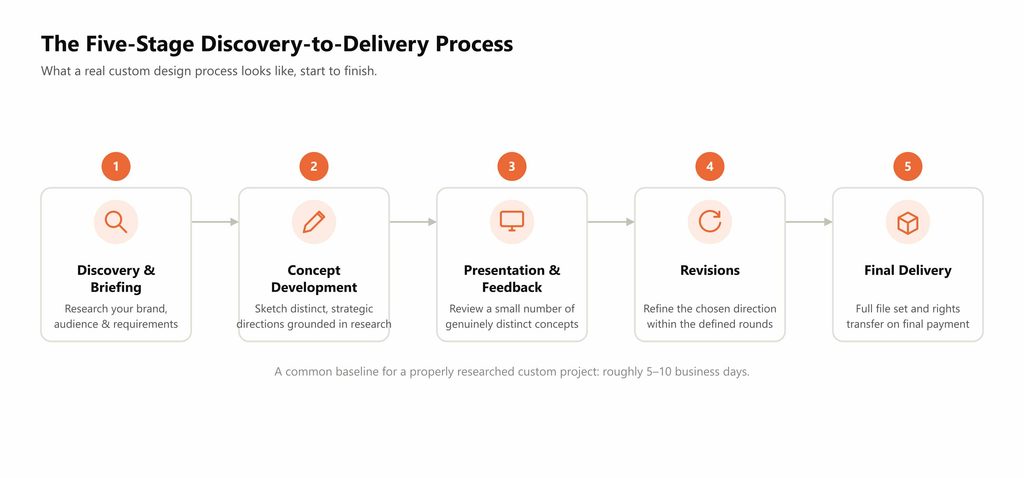
Why it matters: A real design process has identifiable stages — research/discovery, concept exploration, refinement, and final delivery. If a designer can’t describe distinct stages, there’s a good chance they’re skipping research entirely and jumping straight to output.
Good answer: A specific, sequenced description — something like discovery and briefing, concept development based on that research, a presentation of a small number of directions, a defined revision phase, then final file delivery. (This mirrors the five-stage discovery-to-delivery structure most reputable custom design studios — including Graphic Designers Group’s own logo design service — use as a baseline.)
Red flag: “I just start designing based on your industry” or “I’ll send you a bunch of options from my template library to choose from.” Either answer signals no real discovery phase, which means the first concepts you see will be generic guesses, not informed proposals.
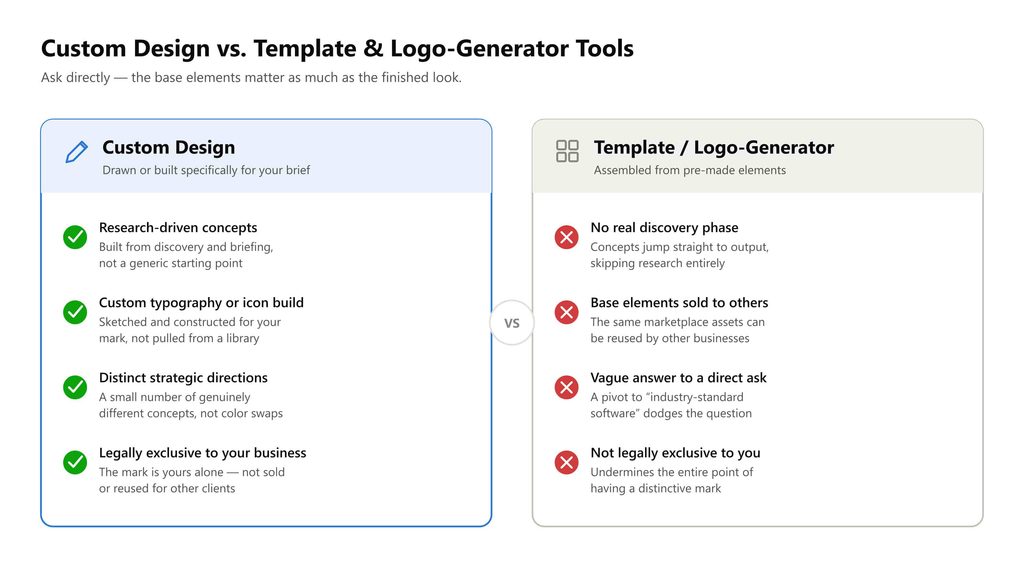
“Are these logos custom-designed from scratch, or built from templates or logo-generator software?”
Why it matters: This is the single most consequential process question you can ask, and it’s the one buyers are most likely to soften or skip because it feels confrontational. It isn’t. A logo assembled from a template marketplace or an automated logo-maker tool is not legally exclusive to you — the same base elements may be sold to, or reused by, other businesses, which undermines the entire point of having a distinctive mark. The difference between custom logo design and logo-maker tools isn’t cosmetic; it’s about whether your mark is actually yours alone.
Good answer: A direct, unhesitating “yes, fully custom, drawn/built specifically for your brief” — ideally with an explanation of how they arrive at concepts (sketching, research-driven direction-setting, custom typography or icon construction).
Red flag: Vagueness, a pivot to “well, we use industry-standard design software” (which dodges the actual question), or reluctance to confirm outright that no template or AI-generation tool was used as the base.
“How many initial concepts will I see, and how are they different from each other?”
Why it matters: One concept isn’t a choice — it’s a take-it-or-leave-it proposal. On the other end, ten near-identical variations of the same idea isn’t real exploration either; it’s padding. You want a small number of genuinely distinct directions, each representing a different strategic angle on your brand.
Good answer: A specific number (commonly two to four) with an explanation that each concept explores a different strategic direction — for instance, one wordmark-led option, one symbol-led option, one more traditional and one more contemporary — rather than color variations of a single idea.
Red flag: “As many as you want until you’re happy” sounds generous but usually means no real concept development happened up front — you’re paying to have the designer think out loud on your dime through endless iteration instead of doing focused strategic work before you ever see a draft.
“What logo styles would you consider for a brand like mine, and why?”
Why it matters: A logo isn’t one category of object — a wordmark, lettermark, pictorial mark, abstract mark, combination mark, and emblem all solve different problems and suit different business types. A designer who can explain which style (or styles) fit your specific brand, and why, is thinking strategically rather than aesthetically.
Good answer: A reasoned recommendation tied to your business specifics — e.g., “Given that your name is highly distinctive and easy to say, a wordmark or lettermark could work well; given that you’re in a visually competitive category, a combination mark might help you stand out at small sizes like a favicon or app icon.”
Red flag: A one-size-fits-all answer, or steering you toward whatever style is fastest for them to produce regardless of your business context.
“Can I see examples of your process work, not just finished logos?”
Why it matters: Polished final logos in a portfolio tell you about taste. Sketches, concept boards, or rationale documents tell you about thinking. If a designer can show early-stage work, it’s strong evidence the “process” they described earlier is real and not just a description on a website.
Good answer: Willingness to share (even a couple of) concept sketches, mood boards, or rationale slides from past projects, with client names redacted if needed for confidentiality.
Red flag: “I don’t keep that stuff” or an unwillingness to show anything beyond the final polished mark.
Category 2: Pricing, Payment, and Contract Questions
Price alone tells you almost nothing about value. What matters is what’s included in that price, when it’s due, and what happens if the project doesn’t go as expected. If you haven’t yet researched what professional logo design typically costs, do that before these conversations — it gives you a baseline to judge whether a quote is unusually high, unusually low, or reasonable for what’s included.
“Exactly what’s included in this price?”
Why it matters: “Logo design” can mean one static file for $50, or it can mean a full package with concepts, revisions, file formats, and usage rights for a few thousand dollars. The number alone is meaningless without the scope attached to it.
Good answer: An itemized breakdown — number of concepts, number of revision rounds, specific file formats delivered, whether color variations and social media versions are included, and whether ownership rights transfer. See the section below on what should be included in a logo design package for a full checklist to compare against.
Red flag: A single flat number with no scope detail, or “it depends” without a follow-up explanation of what it depends on.
“What happens if I need something beyond what’s included — extra concepts, an extra revision round, additional file formats later?”
Why it matters: Scope creep is where budgets quietly balloon. You want to know the overage cost before you’re mid-project and have no leverage to negotiate.
Good answer: A clear, pre-set rate or policy for anything beyond the agreed scope — e.g., a flat fee per additional revision round or per additional concept.
Red flag: No answer, or a rate that seems to be invented on the spot once you ask.
“Do you offer any guarantee if the final logo doesn’t meet what we agreed on?”
Why it matters: A results guarantee — even a modest one — signals that the designer is confident in their process and willing to share risk with you rather than putting all of it on the client.
Good answer: A specific, stated policy — for example, a money-back assurance if the agreed-upon requirements genuinely aren’t met (this is the kind of concrete commitment Graphic Designers Group backs its own projects with).
Red flag: “We don’t offer refunds, no exceptions” with no explanation of what recourse you have if the work falls short of the brief.
“Is there a written contract or scope of work, and what does it cover?”
Why it matters: Verbal agreements and email threads are hard to enforce and easy to misremember. A written agreement protects both sides. The graphic design industry has a long-standing template for this: AIGA, the professional association for design, publishes a Standard Form of Agreement for Design Services built around two components every design contract should include — general business terms and, critically, a dedicated intellectual property provisions section covering who owns what and when.
Good answer: Yes, with a document (however brief) that spells out scope, deliverables, timeline, payment schedule, and — explicitly — who owns the final files and when ownership transfers.
Red flag: “We don’t really do contracts, we just get started once you pay the deposit.” No contract means no enforceable scope, no enforceable timeline, and — as covered in detail below — no enforceable transfer of ownership.
“What’s the payment schedule, and what portion is due upfront?”
Why it matters: A deposit protects the designer’s time; a fair payment schedule also protects you from paying the full amount before you’ve seen or approved any work.
Good answer: A split schedule — commonly a deposit to begin work, with the remaining balance due at or near final delivery, so both sides carry some risk.
Red flag: 100% payment required upfront with no milestone structure, especially from a designer with a thin or unverifiable track record.
Category 3: Ownership and Usage Rights Questions
This is the category buyers most often skip — and it’s the one with the highest financial and legal stakes. Many first-time clients assume that because they paid for a logo, they automatically own it outright. That assumption is not reliably true, and getting it wrong can mean you don’t actually have the legal right to trademark, modify, or exclusively use the mark you paid for.
“Will I receive full ownership and copyright of the final logo, including the right to modify it?”
Why it matters: This needs to be asked in exactly this explicit form — not “is this exclusive to me,” which designers can answer honestly while still meaning something narrower than you think (like exclusive use without full ownership of the underlying copyright).
Good answer: An unambiguous “yes — full copyright ownership and all usage rights transfer to you upon final payment, including the right to modify the mark,” ideally pointing to a specific clause in a written agreement that says so.
Red flag: “You can use it however you want” without addressing copyright ownership specifically, or any answer that implies the designer retains rights to license or resell the design.
“Is that ownership transfer written into the contract, or is it just implied?”
Why it matters: This is where the legal reality surprises most buyers. Under U.S. copyright law, a transfer of copyright ownership is not legally valid unless it exists in a signed written document. Section 204(a) of the Copyright Act states plainly that “a transfer of copyright ownership…is not valid unless an instrument of conveyance, or a note or memorandum of the transfer, is in writing and signed by the owner of the rights conveyed.” A verbal assurance that “of course it’s yours” carries no legal weight without a signed document backing it up.
There’s a second, less obvious wrinkle worth knowing, and it trips up more buyers than any other clause in a design contract. Many agreements describe commissioned work as “work made for hire,” on the assumption that label alone transfers ownership. It usually doesn’t — not for a logo. For work created by an independent contractor (as opposed to an employee), U.S. Copyright Office Circular 30 is specific: a work only qualifies as “work made for hire” if it falls into one of nine narrow, legally defined categories (things like a contribution to a collective work, a translation, or a compilation) and both parties sign a written agreement explicitly stating so.
Logos and other graphic design work don’t fall within those nine categories. That means “work made for hire” language sitting alone in a contract is not a reliable way to secure ownership of a commissioned logo, no matter how official it sounds. What you actually need instead is an explicit, signed assignment of copyright — a different, and more reliable, legal mechanism than a work-for-hire clause. A contract that uses “work made for hire” language for a logo without an accompanying assignment clause has, in practical terms, transferred nothing.
Bottom line: don’t accept “it’s work made for hire” as proof you own your logo. Ask for the specific words “assignment of copyright” in the contract — that phrase is what actually transfers ownership to you.
Good answer: A designer or studio that either already knows this distinction and uses proper assignment language in their contracts, or one that’s willing to add a specific, signed transfer-of-ownership clause to your agreement without pushback.
Red flag: A designer who has never heard the term “assignment of copyright,” insists that a handshake or invoice line item is sufficient, or gets defensive when you ask for the transfer to be documented in writing.
“When exactly does ownership transfer — at final payment, or immediately when I approve a concept?”
Why it matters: Timing matters. If ownership transfers only after final payment, using the logo (on a website, on packaging, in a trademark filing) before that payment clears could put you in a legally ambiguous position.
Good answer: A specific trigger point stated clearly — most commonly, full ownership transfers upon receipt of final payment.
Red flag: No defined trigger point, or an answer that shifts depending on who’s asking.
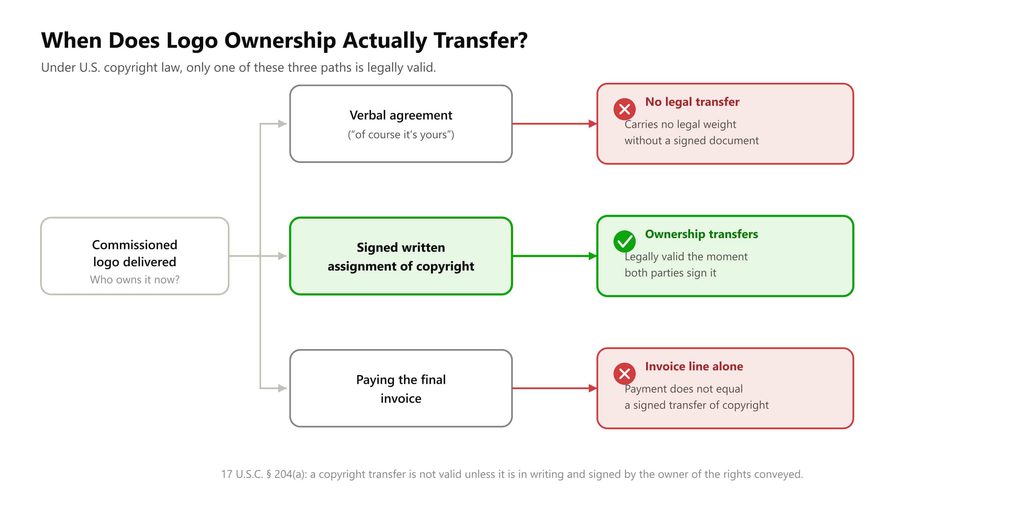
Ownership only transfers with a signed written assignment — not a handshake or an invoice line
“Do you keep any rights to reuse elements of my logo, or showcase it, after the project is done?”
Why it matters: It’s standard and reasonable for designers to display finished work in their portfolio. It is not reasonable for them to reuse structural elements of your specific mark in someone else’s project.
Good answer: “I may show the finished logo in my portfolio unless you ask me not to, but I won’t reuse any design elements from your mark in other client work.”
Red flag: Any hint that concept elements, once created, might resurface in a different client’s project.
Category 4: Communication, Timeline, and Revision Questions
Unclear expectations here are how good-faith relationships turn sour — not because either side acted badly, but because nobody defined “done” or “on time” up front.
“What’s the realistic turnaround time for this project, start to finish?”
Why it matters: You need a planning number, and you need to know if it’s flexible. Custom logo design reasonably takes longer than instant logo-maker tools because real research and iteration take time — a designer promising a finished, refined logo in 24 hours is almost certainly skipping the discovery and concept-exploration stages entirely.
Good answer: A specific range grounded in their actual process — a common baseline for a properly researched, custom project with revisions is roughly 5 to 10 business days, though more complex projects (multiple stakeholders, a full identity system, extensive research) can reasonably take longer.
Red flag: Either “whenever I get to it” (no commitment at all) or an unrealistically fast promise with no explanation of how they’d compress a real process into that timeframe.
“How many rounds of revisions are included, and what counts as a revision?”
Why it matters: “Revisions” means different things to different designers. Does swapping a color count as one? Does requesting an entirely new direction count as a revision, or as a new concept altogether? Get this defined before you start giving feedback.
Good answer: A specific number of included rounds, with a clear definition of what a “round” covers — typically, refinements within an already-chosen direction (color, spacing, minor typography adjustments) rather than a full pivot to a different concept.
Red flag: “Unlimited revisions” sounds appealing but often signals a rushed or unfocused up-front process — and in practice, unlimited revision offers are frequently paired with slower turnaround, since there’s no structural incentive to converge on a final design.
“How will we communicate during the project, and how often should I expect updates?”
Why it matters: A defined communication channel and cadence prevents the two most common frustrations in creative projects: silence that makes you anxious, and check-ins so frequent they slow the actual work down.
Good answer: A named channel (email, a project portal, a scheduled call) and a stated cadence — for example, an update at each major milestone (concepts ready for review, revisions complete, final files delivered).
Red flag: No defined channel, or reliance on you to chase updates rather than the designer proactively providing them.
“Who exactly will be working on my project — you personally, or a team?”
Why it matters: This affects both quality consistency and who to hold accountable if something goes wrong. Neither a solo freelancer nor a team-based studio is inherently better — see the tradeoffs in freelance designer vs. design agency — but you need to know which one you’re actually hiring before you commit.
Good answer: A direct answer naming who does the actual design work and who your point of contact is for questions and feedback, even if those are two different people.
Red flag: Ambiguity about who’s actually doing the design, especially if the person you’re speaking with in sales isn’t the person designing your logo.
“What happens if I’m not satisfied after all included revisions are used?”
Why it matters: You want to know the escalation path before you need it, not after a frustrating back-and-forth with no clear next step.
Good answer: A specific policy — additional revision rounds available at a defined cost, a structured conversation to re-scope the direction, or (as noted above) a money-back assurance tied to the originally agreed requirements.
Red flag: “That doesn’t really happen” as a non-answer, with no actual contingency plan offered.
Category 5: Files, Deliverables, and Final Handoff Questions
This is the category that causes quiet, delayed regret. Everything can go perfectly through concept development and revisions, and then the client discovers weeks later — usually when trying to get the logo printed on a sign or embroidered on a shirt — that they only ever received a small JPG file that looks blurry at any size beyond a business card.
“What file formats will I actually receive?”
Why it matters: Logo files fall into two fundamentally different categories: vector and raster. Vector files (common formats: AI, EPS, PDF, SVG) are built from mathematical paths, so they scale to any size — a billboard or a favicon — without losing quality. Raster files (common formats: PNG, JPG) are built from a fixed grid of pixels; enlarge them past their native resolution and they blur or pixelate, as Adobe’s own explainer on the difference lays out clearly. You need both types for different real-world uses — vector files for anything that gets resized or professionally printed, raster files for quick digital use like email signatures or social posts.
Good answer: A specific list naming both vector formats (typically AI, EPS, PDF, and/or SVG) and raster formats (typically PNG and JPG) — this is the baseline deliverable set for a professional custom logo project.
Red flag: “You’ll get a PNG” as the entire answer. A PNG-only deliverable means you cannot get the logo professionally printed at large scale, cannot easily hand it to a sign maker or embroiderer, and will likely need to pay someone to recreate it from scratch later.
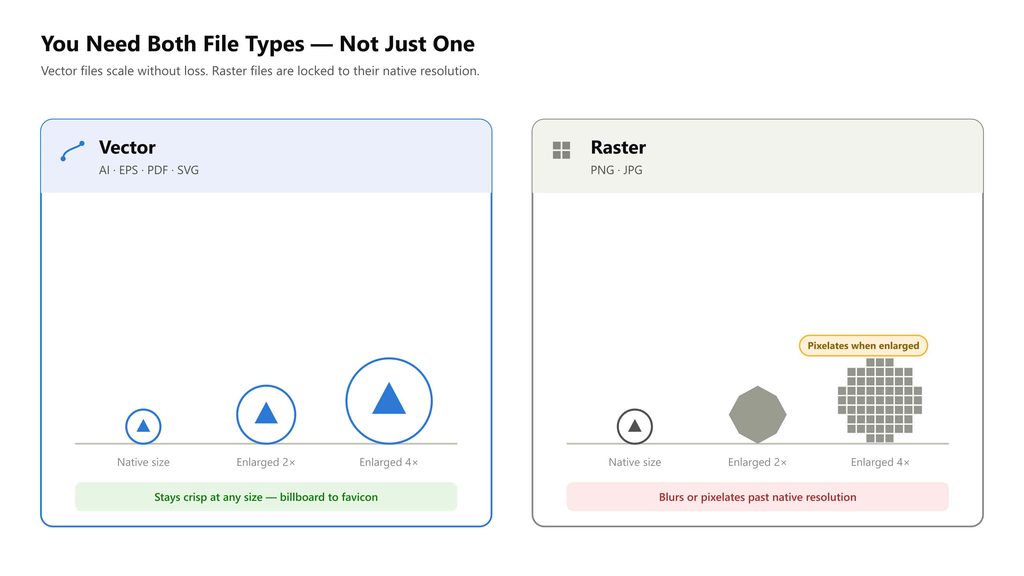
Vector files scale to any size; raster files don’t — you need both
“Will I receive the editable source file, or just flattened exports?”
Why it matters: An editable source file (typically an AI or EPS file with layers intact) lets you or a future designer make small adjustments — a tagline change, a color tweak — without starting over. A flattened export can’t be edited at all.
Good answer: Confirmation that editable source files are included as part of the standard deliverable set, not an optional upsell.
Red flag: Editable source files are withheld unless you pay an additional fee — this effectively holds your own logo hostage for future changes.
“Will I get color variations — full color, black and white, reversed/white-on-dark?”
Why it matters: Your logo needs to work on a white website background, a dark app icon, a black-and-white fax or printed contract, and possibly a single-color embroidered hat. A single full-color-only file fails in most of those contexts.
Good answer: A confirmed set of variations — typically full color, all-black, all-white/reversed, and sometimes grayscale.
Red flag: Only one color version is provided, with no mention of variations for different backgrounds or print methods.
“Do the files include a transparent background, and are social media–sized versions included?”
Why it matters: A logo with a white or colored background box behind it can’t be placed cleanly over a photo, a colored website header, or a video. Social platforms also have their own sizing quirks (profile photos crop to a circle, for instance) that a properly prepared file set should already account for.
Good answer: Yes to both — transparent-background PNG files as standard, and pre-sized or at least export-ready versions for common social platforms.
Red flag: Transparent files are an added cost, or social sizing is left entirely to you to figure out after the fact.
“If I need business cards, letterhead, or other branded materials down the line, is that a separate project?”
Why it matters: A logo is one asset within a broader brand identity. Knowing upfront whether the designer can extend the work — or whether you’ll need to start over with someone else for a professional business card design or other collateral — helps you plan budget and avoid stylistic mismatch between your logo and everything built around it later. It’s also worth clarifying early whether your actual need is a logo alone or a fuller brand identity system, since conflating the two can lead to scope confusion on both sides.
Good answer: A clear answer about whether collateral design is offered, roughly what it would involve, and whether existing brand files (fonts, colors, spacing rules) would carry over smoothly.
Red flag: No clarity on whether follow-on work is even offered, forcing you to solve this question only after you already need the answer.
Category 6: Experience, Portfolio, and Fit Questions
Once process, pricing, ownership, timeline, and deliverables are covered, the remaining question is simpler: is this the right designer for your specific brand? This deserves its own careful evaluation — covered in full in how to evaluate a logo designer’s portfolio — but a few direct questions belong in the interview itself.
“Have you designed logos for businesses in or near my industry?”
Why it matters: Direct industry experience isn’t mandatory — some of the best marks come from designers applying outside perspective to a category — but a designer who has worked across a genuine range of industries (professional services, restaurants, technology, real estate, and beyond, for instance) over several years has likely encountered a wider set of practical constraints than one who has only ever designed in a single narrow niche. Longevity is worth asking about directly, too: a studio that can point to over a decade of client work across varied industries has been tested against real-world revision requests, printer specifications, and trademark filings in a way a brand-new operation simply hasn’t yet.
Good answer: Specific examples, or an honest “not exactly this industry, but here’s comparable complexity/context from other work,” paired with a clear rationale for how that experience transfers.
Red flag: Inability to point to any range of past work, or portfolio samples that all look suspiciously similar regardless of the client’s industry — a sign the designer applies one formula regardless of brief.
“Can I speak to a past client, or see a review from someone in a similar situation to mine?”
Why it matters: A portfolio shows finished output. A reference or review can tell you about the experience of getting there — responsiveness, whether the process matched what was promised, how disputes (if any) were handled.
Good answer: Willingness to share a review, testimonial, or (for a larger project) a reference contact.
Red flag: No reviews or references anywhere, or defensiveness when the question is raised.
“What made your past clients choose you over other options they considered?”
Why it matters: This is a soft question, but the answer reveals how the designer thinks about their own value — whether they lead with price, speed, quality, or something else — and whether that matches what you’re actually prioritizing.
Good answer: A specific, honest answer that aligns with what you’ve already observed about their process and pricing.
Red flag: A generic answer that could apply to literally any competitor, suggesting they haven’t thought carefully about their own differentiation.
A Quick-Reference Checklist for Your Next Call
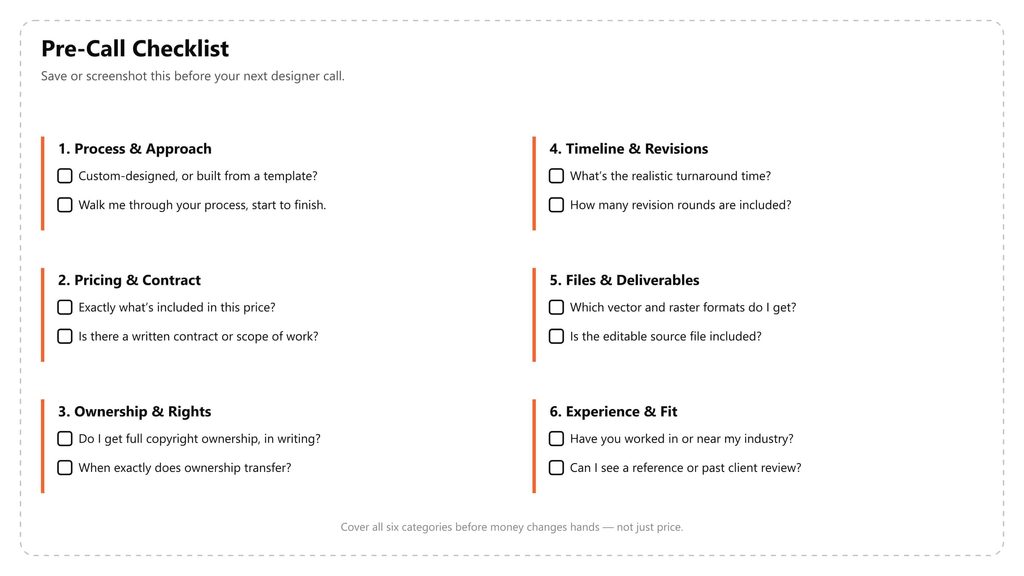
Save or screenshot this before your next designer call
Before you get on a call or send an inquiry email, keep this table nearby so you don’t lose track mid-conversation. It condenses all six categories into the one question that matters most from each, plus the answer that should make you pause.
| Category | Ask This | Red Flag to Watch For |
|---|---|---|
| Process | Custom from scratch? How many distinct concepts, and how do they differ? | A template or AI-generated base, or “as many revisions as you want” |
| Pricing | What’s included, exactly? What triggers an extra charge? | A flat number with no scope detail, or an overage rate invented on the spot |
| Ownership | Full copyright transfer confirmed in writing? When does it transfer? | “Work made for hire” language with no separate signed assignment clause |
| Timeline | Realistic turnaround range? How many revision rounds, defined clearly? | No commitment at all, or an unrealistically fast promise |
| Files | Vector and raster formats included? Editable source file? Color variations? | “You’ll get a PNG” as the entire answer |
| Fit | Relevant range of past work? Any reviews or references available? | No references anywhere, or defensiveness when asked |
How to Weigh What You Hear
Not every hesitant answer is disqualifying on its own — a designer can reasonably say “that depends on your brief” about concept count before they’ve even seen your requirements. What matters is the pattern across categories, not any single imperfect answer:
- Zero red flags across all six categories: proceed with confidence, and get the details in writing.
- One red flag, especially outside ownership or contracts: ask a direct follow-up before deciding — a good designer clarifies without getting defensive.
- Two or more red flags, or any hesitation on ownership specifically: treat that as a real pattern, not a coincidence, and keep interviewing other designers before you commit a deposit.
If a designer answers all six categories clearly, specifically, and in writing, you’ve found someone worth trusting with a deposit. For a deeper look at how these evasive patterns show up in practice, see red flags to avoid when hiring a logo designer; and if you want a structured way to compare multiple designers against each other using the same criteria, what to look for in a professional logo design service walks through that comparison process directly.
Frequently Asked Questions
How many questions should I actually ask a logo designer before hiring them?
There’s no fixed number — what matters is covering all six categories above at least once each. A short, well-chosen question from each category (process, pricing, ownership, timeline, files, fit) will surface almost every major risk. Asking twenty questions all about pricing while skipping ownership entirely leaves you far less protected than asking six questions spread evenly across categories.
Is it rude or unprofessional to ask a designer about copyright and ownership directly?
No. Asking who owns the final work and requesting that the transfer be documented in writing is standard business practice, not an accusation. Any designer with real experience running a design business expects this question and can answer it in one sentence. If a designer reacts defensively to a straightforward ownership question, that reaction itself is useful information.
What if a designer refuses to answer some of these questions, or gets vague?
Treat vagueness on ownership, contracts, or file deliverables as a serious warning sign, not a minor gap to overlook. A designer can reasonably be uncertain about something project-specific (like exact concept count before seeing your brief), but they should never be uncertain about their own standard business terms — those should be settled policies they can recite without hesitation.
Do I really need a written contract for a small logo project, even a low-budget one?
Yes. Contract size should scale with project size, but “no contract at all” isn’t a smaller version of a contract — it’s the absence of one. Given that U.S. law requires copyright transfers to be in a signed writing to be legally valid, even a short one-page agreement covering scope, payment, and ownership transfer protects you far more than an email thread or a verbal understanding, regardless of project budget.
Should I ask about price first, or save it for later in the conversation?
Either order works, but don’t let pricing dominate the entire conversation at the expense of the other categories. It’s common for first-time buyers to spend 80% of a call negotiating price and squeeze ownership and file-format questions into the last thirty seconds. Structure the conversation (or the email) to touch every category, even briefly.
Can I still ask these questions after I’ve already started working with a designer?
Yes, though earlier is better. If you’re mid-project and realize you never confirmed file formats or ownership terms, ask now rather than waiting until final delivery — it’s far easier to add a clarifying clause or confirmation email mid-project than to renegotiate after the final files have already been sent and paid for.
What’s a reasonable price range to expect, so I know if a quote seems off?
Pricing varies widely based on scope (number of concepts, revisions, deliverables, and whether it’s a solo freelancer or an established studio), so there’s no single “correct” number — but comparing quotes side by side using a consistent framework, such as how to choose a logo designer for your small business outlines, will help you judge whether a specific quote is in a reasonable range for what’s included, or a signal that something (either scope or corners cut) doesn’t add up. It’s also worth understanding upfront whether a very cheap logo is actually worth the savings before choosing on price alone.
What if my business eventually outgrows this logo — is that a sign I chose the wrong designer?
Not necessarily. Brands evolve, markets shift, and even a well-designed logo can eventually need updating as a company grows or repositions — that’s a normal part of a business’s lifecycle, not evidence of an initial mistake. If that day comes, knowing when and why to consider a logo redesign will help you evaluate whether it’s actually time, or whether the current mark still has life left in it.
Final Thoughts
None of these questions require legal training or design expertise to ask — they require only that you ask them before money changes hands, not after. A designer who welcomes this level of scrutiny is telling you, through their willingness to engage, that their process can withstand it. One who deflects, rushes past, or gets defensive is telling you something too.
Get every answer in writing wherever it matters most — scope, price, ownership transfer, and deliverables — and you’ll walk into the project with the same clarity and protection you’d expect from hiring any other professional service. That clarity is also exactly what a properly run studio provides by default: a defined five-stage process, itemized deliverables across the full set of file formats, full rights transfer on final payment, and a stated turnaround window rather than a vague promise. If you’d like to see how those specific answers look in practice, Graphic Designers Group’s custom logo design service page lays out its own process, deliverables, and terms in exactly the level of detail this article recommends you look for.
Leave a Reply