Hiring the wrong logo designer doesn’t just cost you money — it costs you time you won’t get back, momentum you can’t easily rebuild, and in some cases the rights to the mark you’re putting on every invoice, sign, and social profile. Most small business owners make this hire once every several years, with no frame of reference for what a normal process, a fair price, or a real red flag looks like.
This article gives you that frame of reference for any of the three main routes: an independent freelancer, a boutique studio offering custom logo design, or a full agency. It walks through exactly how to evaluate a candidate’s portfolio, what questions separate a professional from a hobbyist, what you should realistically expect to pay, and — critically — how to make sure you actually own the logo you’re paying for. By the end, you’ll have a scorecard you can use to compare finalists side by side and make the call with confidence.
What “Choosing the Right Logo Designer” Actually Means
Most first-time buyers reduce this decision to one question: “Do I like their style?” That’s a real factor, but it’s the least reliable one on its own, because style preference doesn’t tell you whether the designer will produce original work, communicate on schedule, or hand over files you can actually use.
A more reliable evaluation looks at five dimensions together:
- Process — Do they follow a defined, repeatable method, or do they just ask you to “send some logos you like” and start guessing?
- Portfolio relevance — Have they solved problems similar to yours, across a real range of industries and styles?
- Communication — Do they explain their thinking, or just deliver images with no rationale?
- Ownership and deliverables — Will you receive full rights and usable files, in writing, before you pay in full?
- Price-to-value fit — Is the price proportionate to what’s included, not just cheap or expensive in isolation?
A designer can score well on style and still fail on the other four — and that combination is exactly what produces the buyer’s remorse stories you’ve probably heard about. The importance of logo design in business growth is well established, which is exactly why the hiring decision deserves more rigor than “I liked their Instagram.”
Step 1: Decide What Kind of Designer You Actually Need
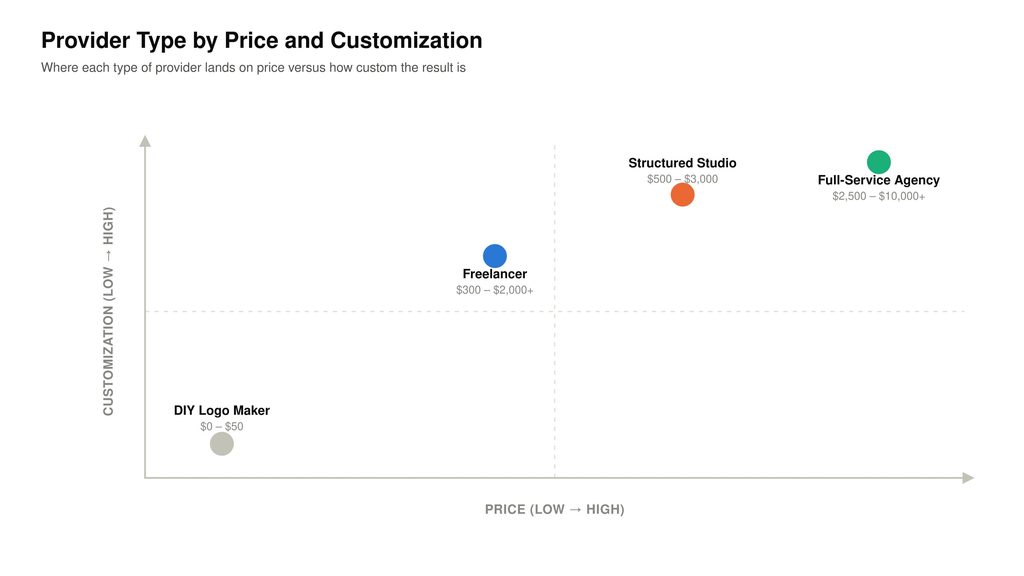
Before you evaluate individuals, narrow down the category of provider that fits your budget, timeline, and quality bar. Each option below serves a genuinely different use case — none of them is universally “best.”
| Provider Type | Typical Price Range | Customization | Best For | Main Risk |
|---|---|---|---|---|
| DIY logo maker (Canva, Looka, etc.) | 0–50 | Very low — assembled from pre-built shapes and fonts | Testing an idea before spending money; extremely tight budgets | Generic look; other businesses can generate near-identical marks |
| Template marketplace | 20–200 | Low — a purchased template edited with your name | Very early-stage side projects | The same template can be resold to other buyers |
| Design contest / crowdsourcing platform | 130–700 | Moderate — many entries, but each gets limited time | Businesses wanting to see many directions fast | Entries are often produced as spec work; AIGA notes spec assignments typically get compressed time and research per entry, which increases the chance of derivative or previously-used concepts |
| Freelance designer | 300–2,000+ | High — custom concepts built around your brief | Most small businesses; the most common route for this budget range | Quality varies widely by experience level; vetting matters more here than anywhere else |
| Boutique design studio | 500–3,000 | High — custom process, often with a defined methodology | Businesses that want agency-level process without agency-level overhead | Fewer big-name credentials than large agencies |
| Full-service agency | 2,500–10,000+ | Very high — often bundled with full brand strategy | Funded startups or businesses needing a complete brand system, not just a mark | Cost and timeline (often 4–12 weeks) may exceed what a single-logo need requires |
Pricing ranges above are general 2026 market benchmarks compiled from published cost breakdowns at ManyPixels and Fiverr; expect variation by region, designer experience, and project scope. Neither report isolates boutique studios as a separate pricing category — that row is estimated here as the natural bridge between the cited freelance and agency ranges, since studios typically price at the upper end of freelance work or the lower end of agency work depending on team size.
For most small businesses, the realistic choice is between a freelance designer and a boutique studio. A comparison of freelancers and design agencies is worth reading in full if you’re torn between the two, since the trade-offs go beyond price — they include how much project management you’ll have to do yourself, how many people will touch your project, and how much strategic input you’ll get beyond the logo itself. If you’re specifically comparing a paid designer against an automated tool, the differences in custom logo design versus a logo-maker tool go deeper than price — they affect whether you’ll ever be able to trademark the result, since a mark assembled from a stock icon library is far harder to register as distinctive.
Wherever you land on provider type, you still have to find actual candidates to evaluate. Referrals from other business owners carry the most built-in vetting, since someone has already tested the working relationship. Beyond that, designer portfolio platforms, professional design directories, and a provider’s own case studies are more reliable starting points than a generic marketplace search, precisely because you can see real, attributable work before you ever send an inquiry.
Step 2: Evaluate the Portfolio Like a Professional, Not a Fan
A portfolio is not a gallery to enjoy — it’s evidence you should interrogate. Apply these checks to every portfolio before you contact anyone:
- Range across industries, not just aesthetics. A designer who has only ever produced minimalist line-art marks may struggle if your brand calls for a bold emblem or a warm, approachable wordmark. Look for evidence they can adapt style to a brief rather than applying one house look to every client.
- Variety of logo types. Professional designers typically work across wordmarks, lettermarks, pictorial marks, abstract marks, combination marks, and emblem logos. If every project in the portfolio looks like a variation on the same template, that’s a signal of a limited process, not a limited imagination.
- Evidence of a process, not just final art. Look for concept sketches, alternate directions that were presented and rejected, or before/after context. A portfolio that only shows finished logos with no visible reasoning tells you nothing about how they think.
- Real client work versus speculative or contest entries. Ask directly whether pieces shown were paid client projects or unused contest submissions. Contest and “concept” work is more likely to be unrefined or never actually implemented.
- Legibility and scalability. Zoom a sample logo down to favicon size and blow it up to billboard size in your head — does the mark hold up, or does fine detail disappear at small sizes? This single check filters out a surprising number of weak portfolios.
- Typography quality in wordmarks and lettermarks. Letterforms should be custom-kerned and intentional, not default font settings with no adjustment. This is one of the fastest tells of a designer’s actual skill level.
This is worth doing thoroughly, because portfolio evaluation is the single highest-leverage step in the whole process — a full breakdown of how to evaluate a logo designer’s portfolio walks through additional checks industry professionals use, including how to spot recycled concepts across a designer’s client list.
Step 3: Vet Their Process — and Why It Predicts the Outcome
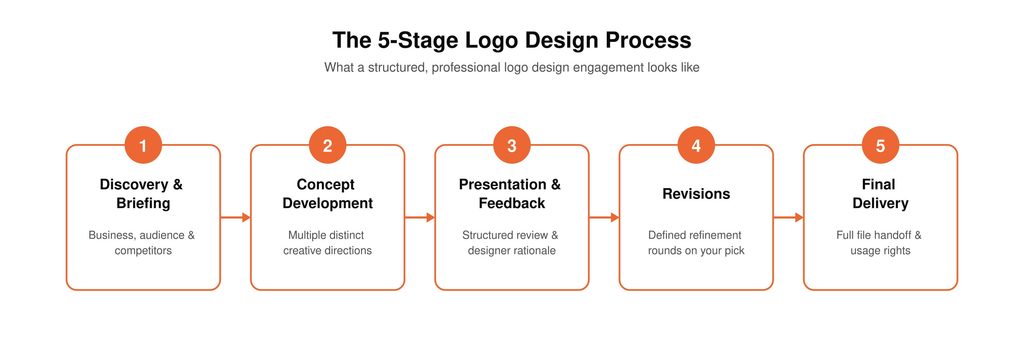
A defined process is one of the strongest predictors of outcome quality, because it forces the designer to gather real information before drawing anything and forces you, the client, to give feedback in structured rounds instead of open-ended “I’ll know it when I see it” cycles.
Ask any candidate to walk you through their process step by step. A professional answer should map to something like this:
- Discovery and briefing — Understanding your business, audience, competitors, and design preferences before any concepts are started. This stage should include real questions about your business, not just a one-line “what do you want your logo to look like.”
- Concept development — Producing multiple distinct directions based on the brief, not one logo with color swapped.
- Presentation and feedback — A structured review where the designer explains the reasoning behind each concept, and you respond with specific, actionable feedback.
- Revisions — A defined number of refinement rounds based on your feedback, applied to the direction you selected.
- Final delivery — A complete handoff of files, variations, and usage rights — not just a single PNG emailed over.
Studios structure this differently in the details, but the five stages above are close to industry standard — it’s how, for example, Graphic Designers Group (a custom logo design studio with 11+ years across professional services, restaurants, tech, and real estate) runs its own engagements, naming discovery and briefing, concept development, presentation and feedback, revisions, and final delivery as five explicit stages. The point isn’t that this exact sequence is the only correct one — it’s that a candidate who can name comparable stages, in whatever order and language they use, is describing a repeatable process rather than improvising one as they go. If a designer can’t describe their process in comparable terms, or the process is “I’ll send you a few ideas and we’ll go from there,” that’s not necessarily disqualifying for a very small budget, but it does mean more of the direction-setting burden falls on you. Getting this input right starts before the first concept is ever drawn — writing a clear design brief is what gives any process, structured or informal, something real to work from.
Step 4: Ask the Right Questions Before You Pay Anything
Use this as a literal script for your first conversation or email. Group your questions by theme so you don’t forget a category under time pressure.
On process and originality
- “Walk me through your process from kickoff to final files.”
- “Are your logos built from scratch, or do you start from templates, stock icons, or AI-generated bases?”
- “How many initial concept directions will I see, and how are they different from each other?”
- “Can you put me in touch with a recent client I could ask about their experience?”
On cost and scope
- “What exactly is included in this price — how many concepts, how many revision rounds, which file formats?”
- “What would trigger an additional charge beyond the quoted price?”
- “Is there a deposit, and is it refundable if the project doesn’t proceed?”
On ownership and rights
- “Will I own full copyright to the final logo, or only a license to use it?”
- “When does ownership transfer — on final payment, or immediately on delivery?”
- “Can you reuse any of the concepts you create for me with other clients?”
On timeline and communication
- “What’s the realistic turnaround from kickoff to final delivery?”
- “How will we communicate during the project, and how quickly can I expect responses?”
- “What happens if I need more revisions than the package includes?”
On deliverables
- “What file formats will I receive, and do they include editable vector source files?”
- “Will I get color variations, a transparent-background version, and social-media-ready sizes?”
How a candidate answers these — specifically, plainly, and without hedging — tells you more than any portfolio image will. If you want the reasoning behind each question and what a red-flag answer sounds like for each one, the full set of interview questions to ask a logo designer breaks down good-answer versus bad-answer patterns question by question.
Step 5: Understand Pricing So You Can Spot Under- and Over-Charging
Published 2026 benchmarks put freelance logo design for small businesses in the 300–2,000 range depending on experience level: entry-level freelancers around 300–500, mid-level (2–5 years’ experience) around 500–1,500, and experienced freelancers 1,500–2,000 and up, according to ManyPixels’ 2026 cost breakdown.
Boutique studios and small agencies land between roughly 500and3,000. Full-service agencies start around 2,500–3,000 and can run past $10,000 when the engagement includes broader brand strategy work, not just a mark.
It’s also worth knowing what buyers actually spend: Fiverr’s own research on logo purchases found that roughly 65% of businesses would pay only up to 500foranewlogo,whileabout151,000 — see Fiverr’s logo design cost data. That gap between what most buyers expect to pay and what agency-level work costs is exactly why freelancers and boutique studios occupy the middle of the market that most small businesses actually use.
| What You’re Paying For | Under $300 | 300–1,500 | 1,500–3,000+ |
|---|---|---|---|
| Number of initial concepts | Often 1, sometimes AI-generated or template-based | Typically 2–4 custom concepts | Often 3–5+ concepts with strategic rationale |
| Revision rounds | Usually minimal or none | Typically 2–3 defined rounds | Often unlimited within a defined period, or several structured rounds |
| File formats | Frequently PNG/JPG only | Vector formats (AI, EPS, SVG) usually included | Full vector source files plus brand usage documentation |
| Ownership transfer | Often unclear or undocumented | Should be explicit in a written agreement | Explicit, documented, typically included by default |
| Strategic input | Minimal to none | Some brief-based reasoning | Deeper competitive and audience research |
Two mistakes cancel each other out here: choosing the cheapest option and getting an unoriginal or unusable result, or overpaying an agency for scope you didn’t actually need. A detailed cost breakdown for professional logo design is useful if you want to sanity-check a specific quote against a wider set of real pricing factors, and if you’re specifically weighing whether to go cheaper, it’s worth reading through whether a bargain-priced logo is actually worth it before you commit — the downstream costs of redoing a weak logo later are rarely factored into the up-front savings.
Step 6: Know the Red Flags That Should End the Conversation
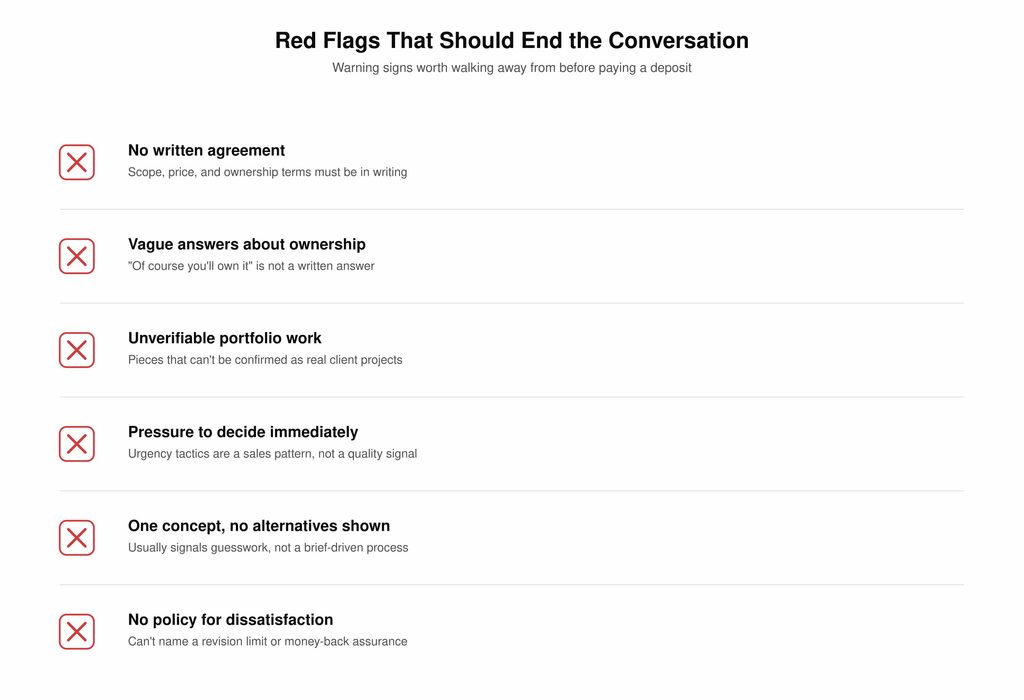
Some warning signs are worth walking away from immediately, regardless of how attractive the price is:
- No written agreement of any kind. If a designer won’t put scope, price, and ownership terms in writing before you pay, you have no recourse if any of those change later — AIGA’s own hiring guidance recommends a written contract detailing the scope of work for exactly this reason.
- Vague or evasive answers about ownership. “Of course you’ll own it” with no written confirmation is not an answer — see Step 7 for exactly what needs to be documented.
- Portfolio pieces that can’t be verified as real client work. Reverse-image-search a few standout pieces if something feels off; recycled stock templates and other designers’ portfolio pieces do get reused.
- Pressure to decide or pay immediately. Legitimate designers can hold a start date for a reasonable, brief window. Urgency tactics are a sales pattern, not a design-quality signal.
- A single concept with no explanation of alternatives considered. This usually indicates guesswork rather than a brief-driven process.
- Refusal to specify what happens if you’re not satisfied. A designer confident in their process should be able to name a specific policy — for example, a defined revision limit plus a money-back assurance if the agreed-upon requirements genuinely aren’t met — rather than a vague “we’ll work it out.”
- Design contest or “we’ll show you dozens of options for one flat fee” pitches with no named individual designer. As covered in Step 1, this model runs on compressed-time speculative submissions, which the design profession’s own standards body flags as a quality and originality risk — see AIGA’s official position on spec work.
None of these individually means fraud, but any one of them should slow you down, and two or more together is a legitimate reason to walk away before paying a deposit. A poorly chosen designer doesn’t just waste a budget — poor logo design can actively work against your business by undermining the credibility a logo is supposed to build in the first place, which is precisely why these checks matter more than they might seem to at the outset.
Step 7: Confirm Ownership, Files, and Deliverables Before You Sign
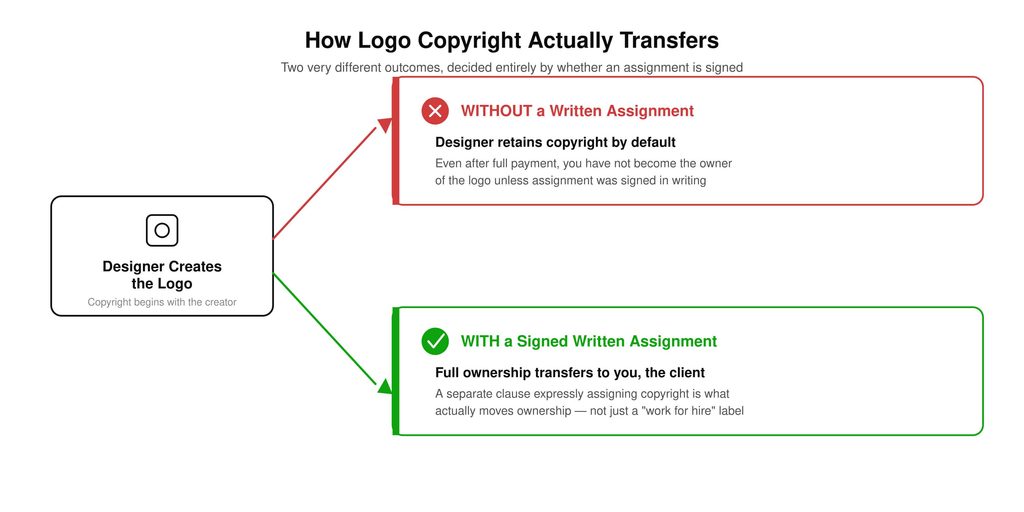
This is the step most first-time buyers get wrong, and it’s the one with the most serious long-term consequences.
Here’s the legal reality: under U.S. copyright law, a commissioned work created by an independent contractor is not automatically owned by the business that paid for it. Per the U.S. Copyright Office’s Circular 30 on works made for hire, a commissioned work only qualifies as “work made for hire” if it falls into one of nine specific statutory categories — contributions to collective works, parts of audiovisual works, translations, and a handful of others — and there’s a signed written agreement expressly stating it’s a work made for hire. (This describes U.S. law specifically; if you or your designer are based elsewhere, the default ownership rule in your country may differ, so confirm the equivalent assignment requirement locally — but the underlying advice below, get the assignment in writing, holds regardless of jurisdiction.)
A logo does not fall into any of those nine categories in ordinary circumstances. That means even a signed “work for hire” clause is not enough on its own to make you the owner. What actually transfers ownership is a written copyright assignment: a separate clause where the designer explicitly assigns their copyright in the finished work to you. Without that assignment in writing, the designer retains copyright by default, even after you’ve paid in full — which in practice means they could legally require you to stop using the logo, license the same mark to someone else, or resell it outright, a dispute buyers who skipped this step have genuinely ended up in.
Before you sign anything or make final payment, confirm in writing:
- Full copyright assignment, not just a usage license, unless a license genuinely fits your situation.
- When ownership transfers — ideally on final payment, stated explicitly.
- Complete source files, not just exported images. You want editable vector formats (AI, EPS, PDF, SVG) in addition to raster formats (PNG, JPG) for everyday use.
- Color and background variations, including a transparent-background version and any social-media-sized exports you’ll need for profile images and covers.
- No reuse restriction working against you — confirm the designer won’t reuse your specific concept for another client, even if they retain the right to showcase it in their own portfolio (a normal, reasonable ask on their part).
A complete deliverable package should look something like this: full-color and single-color logo variations, vector source files, raster exports, a transparent-background version, social-ready sizes, and full ownership documentation. What should be included in a complete logo design package covers this checklist in more depth if you want to compare it against a specific quote you’ve received.
Step 8: Set a Realistic Timeline and Revision Expectations
Timelines vary by provider type more than almost any other factor. DIY tools and template purchases can be instant. Freelancers commonly deliver in roughly 5–10 business days for a straightforward logo project, though timelines stretch with more revision rounds or a more involved discovery phase. Boutique studios often run in a similar window when working from a clear brief. Full-service agencies handling logo work as part of a larger brand identity engagement frequently take 4–12 weeks, because the scope includes strategy and system work well beyond the mark itself.
Two timeline claims should make you pause rather than relax: a logo delivered in under 24 hours for a meaningfully custom project (this usually signals a template or automated tool, not original concept development), and a freelancer who can’t give you any estimate at all (this usually signals disorganization that will cost you time later, not flexibility). For a fuller breakdown of what affects turnaround and how to set expectations with a specific candidate, typical logo design timelines and what affects them unpacks the variables in more detail — briefing clarity, number of revision rounds, and how quickly you respond to reviews all move the number more than most buyers expect.
A Simple Scorecard: Comparing Your Shortlisted Designers Side by Side
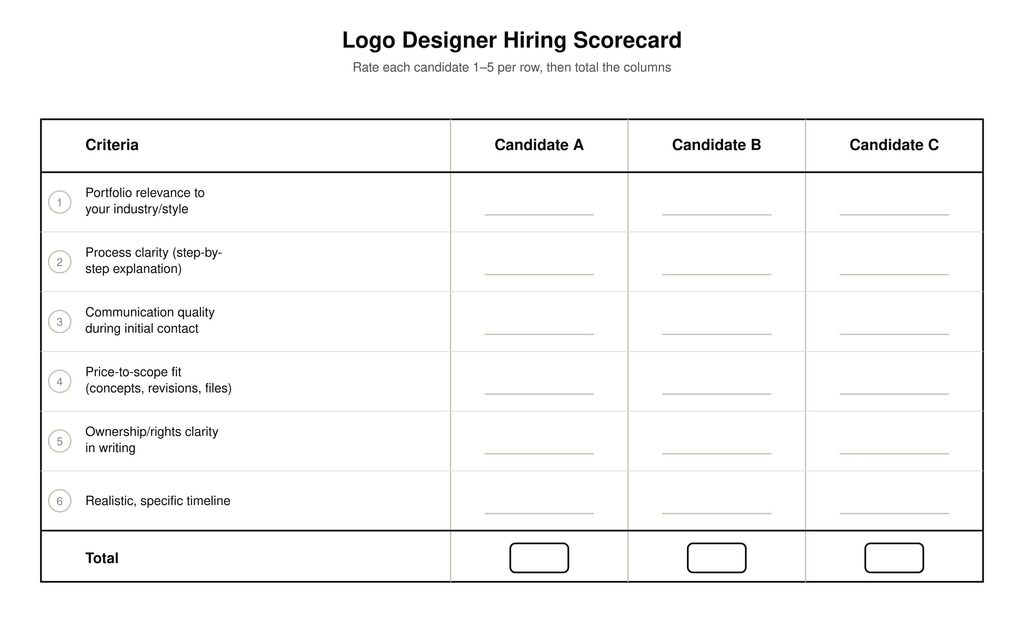
Once you have two or three finalists, score each one against the same criteria instead of relying on gut feeling alone. Rate each row 1–5 for every candidate and total the columns.
| Criteria | Candidate A | Candidate B | Candidate C |
|---|---|---|---|
| Portfolio relevance to your industry/style | |||
| Process clarity (could they explain it step by step?) | |||
| Communication quality during initial contact | |||
| Price-to-scope fit (concepts + revisions + files for the price) | |||
| Ownership/rights clarity in writing | |||
| Realistic, specific timeline | |||
| Total |
This is deliberately simple enough to fill out in ten minutes per candidate, and it forces you to weigh the factors from Steps 1 through 8 together rather than letting one strong portfolio image override every other consideration.
Common Mistakes First-Time Hirers Make
The red flags in Step 6 are about designer behavior. These are about buyer behavior — patterns that undermine even a good designer’s ability to deliver well:
- Choosing on price alone. The cheapest quote and the best value are rarely the same option once you factor in ownership, originality, and revision scope.
- Skipping the brief. Handing a designer a one-line description (“modern logo, blue, for a coffee shop”) produces generic concepts because there’s nothing specific to respond to. A real brief takes 20–30 minutes to write and saves multiple revision rounds later.
- Having no single decision-maker. When feedback comes from five different people with five different opinions, revisions become contradictory and the project stalls. Designate one person to consolidate feedback before it goes to the designer.
- Giving vague feedback. “I don’t love it” gives a designer nothing to act on. “The icon feels too literal — I’d like to see a more abstract interpretation” gives them a direction.
- Skipping the contract to save time. A short written agreement covering price, scope, timeline, and ownership takes minutes to draft and protects both sides if anything goes sideways.
- Confusing “more revisions” with “better direction.” Endless open-ended revision rounds without clear feedback rarely converge on a better result — they usually just delay a decision that structured feedback would have reached faster.
Frequently Asked Questions
How much should a small business realistically budget for a logo? For most small businesses working with a freelancer or boutique studio, a realistic range is 300to2,000, depending on the designer’s experience level and what’s included (number of concepts, revision rounds, and file formats). Full brand identity pricing for a small business runs higher, since a logo is only one component of that scope.
Can I use a free logo maker instead of hiring a designer? You can, and for a very early-stage test it may be a reasonable stopgap. The trade-off is that logo-maker outputs are assembled from shared icon and font libraries, so the result is rarely fully distinctive, which can matter later if you want to trademark your mark or want a logo other businesses in your area haven’t also generated. See Step 1 above for exactly where custom design and automated tools diverge in practice.
How many logo concepts should I expect to see? Most professional freelance and studio engagements present somewhere between two and five distinct initial directions, each grounded in the brief rather than random variations of one idea. Fewer than two concepts with no explanation of alternatives considered is worth asking about directly.
What if I don’t like any of the initial concepts? A professional process should have a defined path for this — typically an additional discovery conversation to recalibrate direction, followed by a new round of concepts, rather than treating it as an open-ended, unlimited restart. Confirm before you start how this scenario is handled and whether it’s included in the price.
Do I need a full logo or a complete brand identity? It depends on how much of your customer-facing presence you’re building at once. A standalone logo covers your primary mark; a full brand identity extends that into color systems, typography rules, and usage guidelines across your whole business. Deciding between a logo alone and a complete brand identity is worth reading if you’re launching multiple touchpoints — a website, packaging, signage — at the same time as your logo, since designing them together is usually more consistent than adding pieces one at a time.
How long does the whole process take? For a freelancer or boutique studio, 5–10 business days is a common realistic window for a logo-only project with a clear brief. Full brand identity engagements through an agency commonly run 4–12 weeks. Add time for slower feedback turnaround on your end — the designer’s calendar isn’t the only variable.
What happens if the designer disappears mid-project? This is exactly why a written agreement with a defined payment schedule matters — ideally structured so a meaningful final payment isn’t due until final files are delivered. If you paid a deposit and lost contact, document your communication attempts and, depending on payment method, contact your payment provider about a dispute; this is also why verifying a designer’s real portfolio and reachable contact information before paying anything (Step 2) is worth the extra ten minutes.
Can I use my logo on merchandise and social media immediately after delivery? Yes, once you have full copyright ownership documented in writing and the appropriate file formats (transparent PNG for digital use, vector files for print and merchandise). If your project also needs printed collateral, designing a professional business card is a natural next step once your logo files are finalized, since card layouts are built around the same mark and color system.
I already have a logo — how do I know if I need a new designer or just a refresh? If your existing logo is legally yours, technically usable, and the issue is that your business has outgrown it rather than that it was poorly made, you may be looking at a redesign rather than starting from zero. When a logo redesign makes more sense than starting over covers how to tell the difference and what a rebrand process typically involves compared with a first-time logo project.
Final Recommendation
Reduce this decision to four filters: a designer who follows and can explain a real process, a portfolio that shows range and reasoning rather than one repeated look, written and explicit ownership terms, and a price that’s proportionate to what’s actually included. Everything in this piece — the provider comparison, the vetting questions, the pricing benchmarks, the red flags — exists to help you check those four things quickly instead of guessing.
Use the scorecard above on your top two or three candidates before you commit. If a candidate clears all four filters and the process feels transparent rather than rushed, you have what you need to hire with confidence. And if you want a broader checklist for evaluating any provider — freelancer, studio, or agency — against professional standards before you sign anything, what to look for in a professional logo design service is a useful final gut-check before you make the call.
Leave a Reply