Hiring a logo designer is a small transaction with an outsized ability to go wrong. Most first-time buyers focus on price and turnaround time. Weeks later, they discover the real risks were somewhere else entirely: a portfolio that wasn’t actually the designer’s own work, a file delivery that leaves them unable to print a business card, or a contract so vague that nobody can say who legally owns the mark they paid for.
None of these problems are rare or exotic. They follow patterns, and every pattern leaves a detectable signal before you pay a deposit. This article organizes those signals into four categories — portfolio, pricing, communication and process, and contract and rights — plus a fifth category specific to a newer deception: generic logo-maker output resold as “custom” design. Read it as a screening checklist, not a horror story. By the end, you’ll know exactly what to check, what question to ask when something feels off, and what a legitimate engagement looks like by contrast.
Why Logo-Designer Vetting Deserves Real Scrutiny
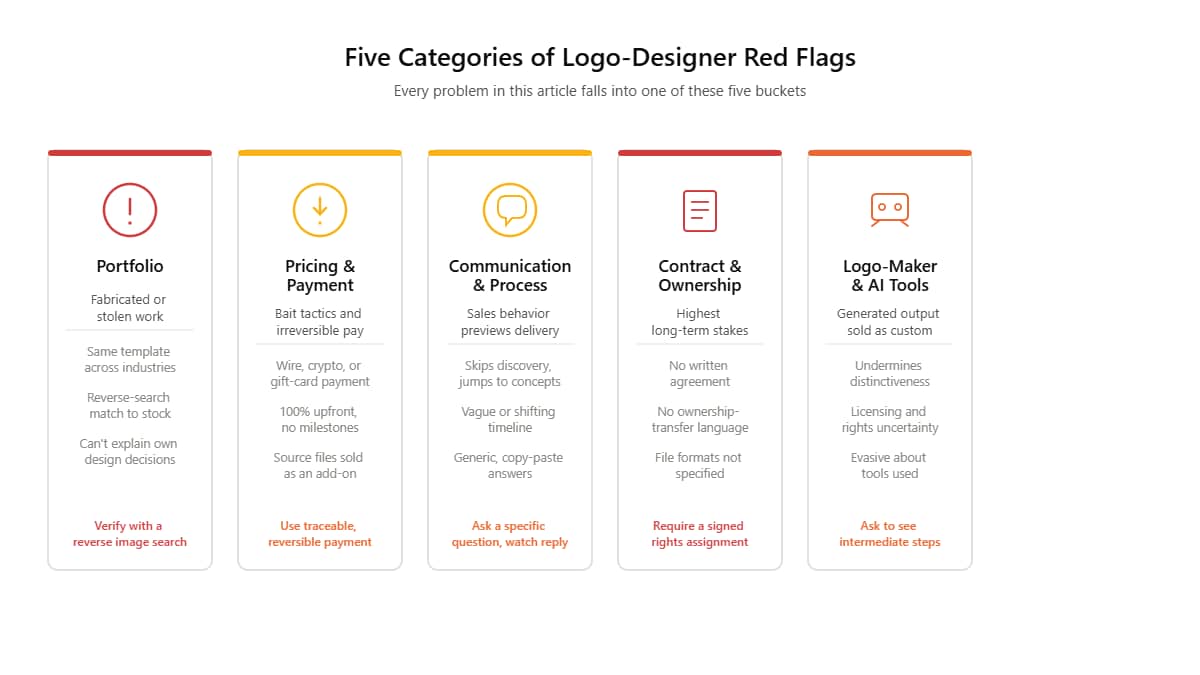
A bad hire here doesn’t just cost the money you paid — it costs the time you didn’t have to lose. If you discover at launch that your files are low-resolution JPGs with no vector source, you’re back to square one days before you needed marketing materials, signage, or a website header. If a designer’s “portfolio piece” turns out to be a stock template with your business name pasted over it, you may be using a mark that dozens of other small businesses are also using. That directly damages how recognizable and distinct your brand can become — the entire reason logo design contributes to business growth in the first place.
The legal exposure is easy to underestimate too. If a designer lifted visual elements from an existing trademarked or copyrighted design, you could be using a mark that infringes someone else’s rights. That problem typically surfaces only after you’ve printed materials, built a website, and told customers to recognize it. A quick, free search of the USPTO’s trademark database for your business name and industry category before you finalize anything is a reasonable safeguard regardless of how confident you are in the designer — it takes minutes and catches conflicts before they become expensive. And if the contract (or lack of one) never actually transferred ownership to you, you may not legally own the asset you paid for at all; that risk is explored in detail below. Even short of outright fraud, a rushed or poorly briefed design process tends to produce a generic, forgettable mark. A weak logo has its own downstream cost to how customers perceive and trust the business. None of this is inevitable. It’s avoidable with five categories of checks.
Portfolio Red Flags
The portfolio is the first thing you evaluate and the easiest thing to fake. Here’s what to look for, and how to actually verify it rather than just eyeballing it.
The work looks suspiciously polished and generic at the same time
Real client work has quirks. Styles vary across projects because different businesses have different needs, simpler marks sit alongside more elaborate ones, and you can see the thinking behind why a shape or color was chosen. Fabricated portfolios don’t have that variation. Watch for the same layout repeated across a dozen unrelated industries — circle badge, icon on top, wordmark underneath — with nothing distinguishing one client from the next. That’s a sign you’re looking at someone who resells pre-made designs, not someone who designs from scratch for each client.
Run a reverse image search before you trust the portfolio
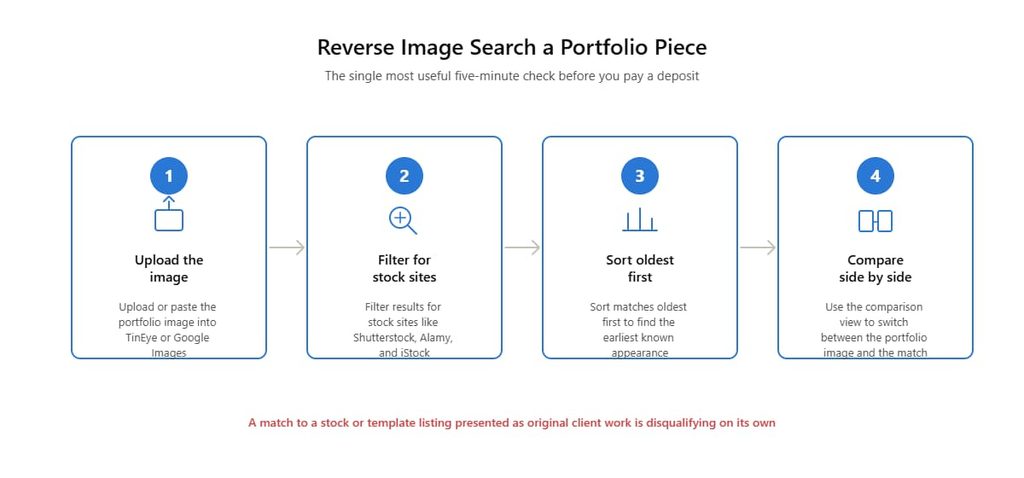
This is the single most useful five-minute check in this entire article, and almost no one does it. Upload a portfolio image to a reverse image search tool such as TinEye or Google Images. TinEye’s own guidance on how to use the tool to verify an image walks through the exact steps:
- Upload or paste the image.
- Filter results specifically for stock photography sites like Shutterstock, Alamy, and iStock.
- Sort matches by oldest first to find the earliest known appearance of a design.
- Use the comparison view to switch back and forth between the portfolio image and the match it finds.
If a “custom logo” the designer claims to have created for a past client shows up as a stock vector, a logo-maker template, or another freelancer’s older portfolio piece, you’ve caught a fabricated portfolio before paying anything. A match alone isn’t automatic proof of theft; TinEye itself notes that a match doesn’t prove infringement on its own, so you’d still confirm licensing and context. Even so, a designer’s portfolio piece matching a stock marketplace listing is disqualifying on its own.
They can’t explain their own design decisions
A designer who genuinely created the work can answer in specifics. Ask any candidate to walk you through one portfolio piece: why that shape, why that color palette, what the client’s brief was, what alternative concepts they considered. Someone presenting borrowed or outsourced work tends to give vague, generic answers (“it just fit the brand”) because they don’t actually know the reasoning — because they weren’t the one reasoning through it. This single question is more reliable than reading testimonials, because testimonials can be faked but on-the-spot design reasoning is very hard to fake convincingly.
No process artifacts, only finished files
A working designer typically has something to show beyond the final PNG — initial sketches, concept variations that didn’t get chosen, a moodboard, or notes from the discovery conversation. Not every freelancer archives all of this, so its total absence isn’t disqualifying by itself. Paired with any of the flags above, though, it strengthens the case that you’re looking at resold or AI-generated work rather than an original design process. For a fuller framework on what a strong, legitimate portfolio actually demonstrates beyond just fraud-avoidance, see how to evaluate a logo designer’s portfolio.
Pricing & Payment Red Flags
Price alone doesn’t tell you whether a designer is legitimate. But certain price and payment patterns are reliable warning signs.
Extremely low flat fees with no discovery process
A 5–5–25 logo almost never involves a real design process. There’s typically no discovery conversation about your business, audience, or competitors, no genuine concept exploration, and often no revisions. At that price point, the economics only work if the “designer” is customizing a pre-built template or running your business name through a logo-generator tool and delivering the output as-is. That doesn’t automatically make it a scam — you’re getting exactly what the price implies. But it does mean you should not expect a distinctive, ownable mark, and you should verify file formats and rights explicitly before paying, since those are often the part that’s missing. For a grounded look at what you actually give up at that price tier, see is a cheap logo worth it, and for realistic market pricing by project scope, see how much professional logo design costs.
“Unlimited revisions forever” with no other structure
This sounds generous but functions as a bait tactic in two ways. It can be used to justify never actually finalizing a concept, keeping you paying for “just one more round.” Or it signals a workflow with no defined process, milestones, or endpoint, which tends to produce scope creep and delay rather than a better result. A legitimate engagement defines a specific number of revision rounds within a defined process — that structure protects both sides and keeps the project moving toward delivery.
Payment demanded 100% upfront, with no milestone structure
Some upfront deposit is completely normal and reasonable — it secures the designer’s time and filters out non-serious inquiries. What’s a red flag is being required to pay the entire project fee before any concepts are shown, with no structure tying remaining payment to delivery. This removes your only real leverage if the delivered work doesn’t match what was promised.
Payment requested by wire transfer, cryptocurrency, or gift cards
Insisting on a payment method that can’t be reversed is a red flag independent of price or portfolio quality. A legitimate designer accepts traceable, reversible methods — a credit card, PayPal, or a platform’s built-in escrow — because those give you recourse if something goes wrong. Wire transfers, cryptocurrency, and gift cards give you none: once sent, the money is effectively unrecoverable, which is exactly why scammers across freelance categories prefer them. If a candidate pushes for one of these methods specifically, treat it as disqualifying on its own, regardless of how reasonable the rest of the conversation has sounded.
Contest or “spec work” platforms where dozens of designers work for free
Some crowdsourcing platforms have multiple designers submit finished concepts on speculation, and only the one you pick gets paid. This isn’t outright fraud — it’s a disclosed business model — but it’s worth understanding before you use one. Because most participants are paid nothing for their work, it attracts high volumes of fast, derivative submissions rather than a considered process built around your specific brief. The professional design community, including groups like AIGA, has long treated speculative work as an industry practice to avoid for exactly that reason. If you use a platform like this, apply the same portfolio and process checks in this article to whichever entrant you’re considering — the crowdsourced format doesn’t exempt them.
Source files are sold as a separate add-on
Watch for pricing pages or quotes where the “logo” is one price and the “source files” cost extra, sometimes significantly more than the base logo fee. The source files are the editable vector files you need for professional printing, signage, and future edits. This structure is functionally a bait-and-switch: the item you actually need to use the logo professionally is withheld unless you pay again. Confirm before you pay what file formats are included in the base price — this is covered in more detail in the contract and rights section below.
Artificial urgency (“this rate expires today”)
Pressure to decide immediately, before you’ve had time to compare candidates or think it over, is a tactic borrowed directly from broader freelance and gig-work scams, not something specific to design. The FTC’s guidance on side-hustle and freelance work scams names this pattern directly: legitimate opportunities let you take time to consider, while scammers insist you accept immediately or lose the offer. Legitimate providers with a real backlog of client work don’t need to manufacture urgency to get you to commit. The same guidance also recommends a check worth applying to any independent designer, not just platform-based gigs: search their name or business name alongside words like “complaint,” “review,” or “scam” before you pay anything. And if they’ve worked with past clients, ask to briefly hear about that experience directly.
Communication & Process Red Flags
How a designer operates during the sales conversation is a strong preview of how they’ll operate during the actual project.
They skip discovery entirely
Starting to produce “logo options” before asking a single question isn’t efficiency — it’s a sign the output will be generic. If a candidate is willing to jump straight to concepts without asking about your business, your target customers, your competitors, or what you want the logo to communicate, that’s the tell. A real design process starts with a structured discovery step, often formalized as a creative brief, because the brief is what keeps the concepts relevant to your actual business instead of being interchangeable with any other client’s. If you want to see what a strong discovery input looks like from your side, how to write a logo design brief walks through it.
No clear process or timeline before you commit
You should be able to get a straight answer to “what happens after I pay the deposit, and by when will I see the first concepts?” before you commit to anything. A designer who can’t describe their own process in concrete steps — or gives you a wildly different timeline in every conversation — is unlikely to run a project any more consistently than they can describe one. Timeline expectations vary by scope, but there’s a reasonable, well-documented range you can benchmark any quote against; see how long professional logo design takes.
Generic, copy-paste responses to specific questions
A designer paying attention answers the actual question, with an actual opinion. Ask a candidate something specific — “my industry is regulated and competitors mostly use blue, do you have a point of view on whether I should follow that convention or break from it?” A red-flag response ignores the specifics and returns something like “we create unique and professional logos tailored to your brand” — an answer that would fit literally any question, because it wasn’t written in response to this one. That mismatch, not tone or friendliness, is the signal: either the freelancer is juggling far more simultaneous clients than they can properly serve, or they’re not actually reading what you send. Either way, it predicts frustration later in the project when precision matters more.
No structured way to give feedback
A real revision process has a mechanism: you review concepts, provide specific written feedback tied to specific elements, and get a revised version that responds to that feedback. If a designer’s idea of “revisions” is an unstructured back-and-forth with no clear record of what was requested and what was delivered, disputes later about whether they met your requirements become nearly impossible to resolve. The same problem shows up in freelance marketplace dispute processes: clients are specifically advised to keep dated records of requested changes, because vague, undocumented feedback threads are what platform dispute reviewers weigh most heavily.
Contract, Ownership & Rights Red Flags
This is the category with the highest long-term stakes, because it determines whether the logo you paid for is legally, unambiguously yours.
No written agreement at all
A logo project conducted entirely over chat messages, with no written scope, deliverables, or terms, is a red flag regardless of price point. Verbal or informal understandings leave both parties guessing about what was actually promised. They also leave you with essentially no leverage if the final deliverable doesn’t match what you expected.
Vague or absent language about who owns the finished logo
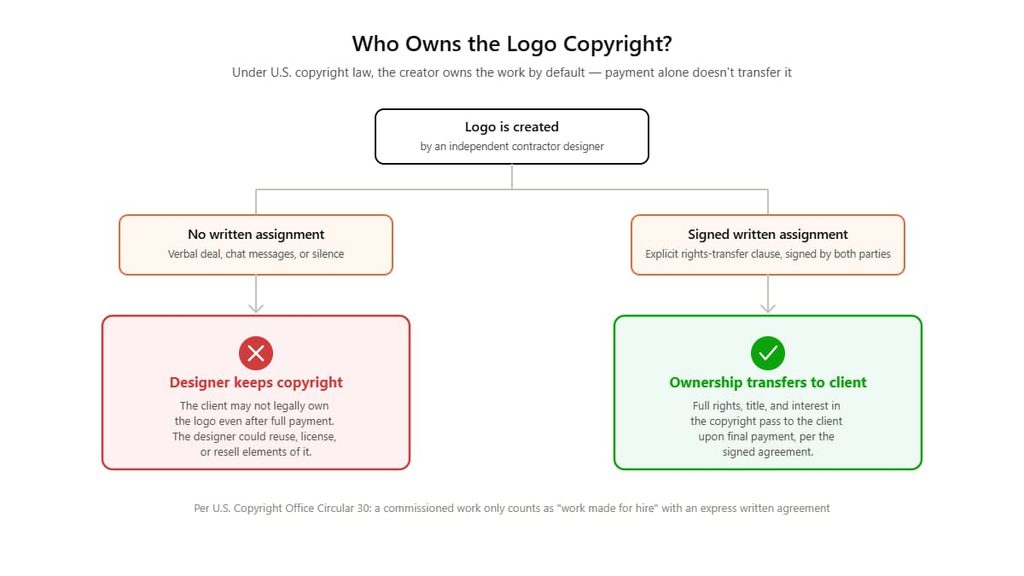
This is the single most misunderstood risk in freelance creative work, and it’s worth being precise about it. Under U.S. copyright law, the default rule is that the creator of a work owns the copyright, not the person who paid for it. An employee’s work automatically belongs to their employer, but an independent contractor is not an employee.
For a commissioned work to legally count as a “work made for hire” that transfers ownership to the paying client, U.S. Copyright Office Circular 30 is explicit that it requires an express written agreement, signed by both parties, that satisfies the statutory requirements — and even then, only certain categories of commissioned work qualify. If a work fails to meet those requirements, the circular is clear that it is not a work made for hire, which means the creator keeps the copyright by default.
Practically, this means: if you hire a freelance logo designer and never sign anything that assigns or transfers the copyright to you, the designer may still legally own the logo you paid for, even after full payment. They could theoretically reuse elements of it, license it to someone else, or dispute your exclusive use of it. A contract or invoice terms that explicitly state the client receives full ownership and rights upon final payment is not a formality — it is the entire mechanism by which the ownership actually transfers to you. The specific language to look for is an assignment clause, something to the effect of “the designer assigns all right, title, and interest in the copyright to the client upon receipt of final payment.” If the contract or invoice only says you’re getting a “license to use” the logo, that’s a different and weaker right than ownership, and it’s worth asking directly why.
The designer reserves the right to reuse “your” design
Watch for contract language that lets the designer showcase, resell, or reuse elements of the design after delivery, when a contract exists at all. A limited right to display the finished logo in the designer’s own portfolio for self-promotion is standard and reasonable. A right to reuse the design elements for other clients, or to resell the same concept, is not. That defeats the entire purpose of a custom, one-of-a-kind mark.
No specification of what file formats you’ll receive
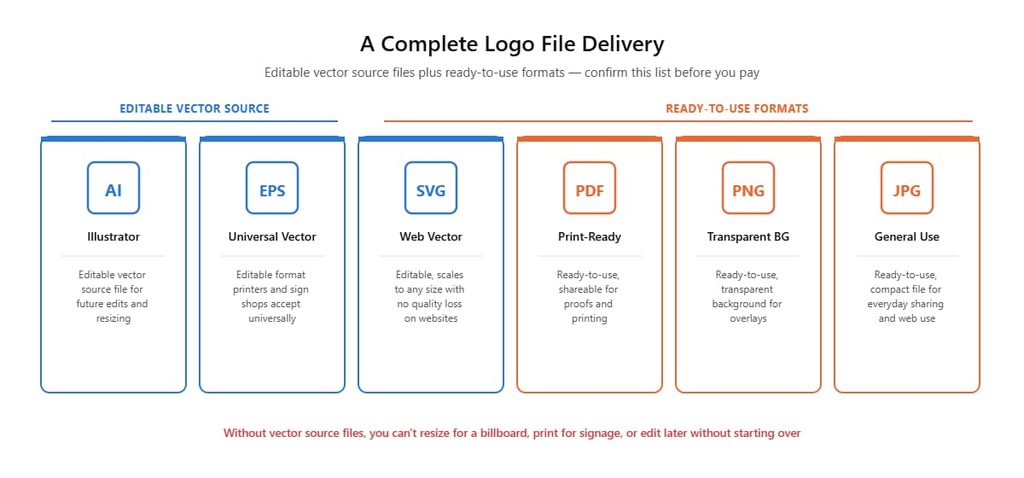
What a complete logo file delivery should include, and why each format matters
“You’ll get your logo” is not a deliverables list. A professional engagement specifies the exact file types up front, typically including editable vector source files (AI, EPS, or SVG) plus ready-to-use formats (PDF, PNG, JPG) in multiple color variations and with transparent backgrounds available. Vector source files matter enormously and are the thing most often withheld or upsold separately: without them, you cannot resize the logo for a billboard without quality loss, hand it to a printer for large-format signage, or make future edits without starting over from scratch. Confirm this list explicitly before paying — what should be included in a logo design package lays out the full standard deliverable set to check your quote against.
No stated remedy if the work doesn’t meet requirements
A legitimate provider has an answer to this before you ask: what happens if, after the agreed revision rounds, the delivered logo genuinely doesn’t meet what was scoped in the brief? The answer might be additional revision rounds, a partial refund, or a money-back assurance tied to meeting the agreed requirements. The absence of any stated answer means you’re fully exposed if the engagement goes sideways.
Logo-Maker & AI-Tool Red Flags Disguised as “Custom” Design
A newer version of portfolio fraud involves designers running your business name through an automated logo-generator or AI image tool, then delivering the output as if it were bespoke, hand-designed work. This matters for two concrete reasons. First, generated marks are frequently built from the same limited icon and layout libraries other users of the same tool are also drawing from. That undermines the distinctiveness a logo is supposed to provide. Second, the underlying assets may not be fully unique or clearly licensed for exclusive commercial use. That can create the same rights uncertainty covered above — you may not actually have exclusive, defensible ownership of a mark that other businesses are also generating from the same tool.
The tell is usually in the process, not the output alone. Ask what software or method they use to create concepts, and whether you can see intermediate variations or sketches rather than just a single finished result. A designer working manually in vector illustration software can describe their tools and process specifically. Someone reselling generator output tends to be evasive about exactly this question. For a direct comparison of what separates genuine custom design from automated logo-maker output — including where each is actually appropriate — see custom logo design vs. logo maker for small business.
How Many Red Flags Is Too Many?
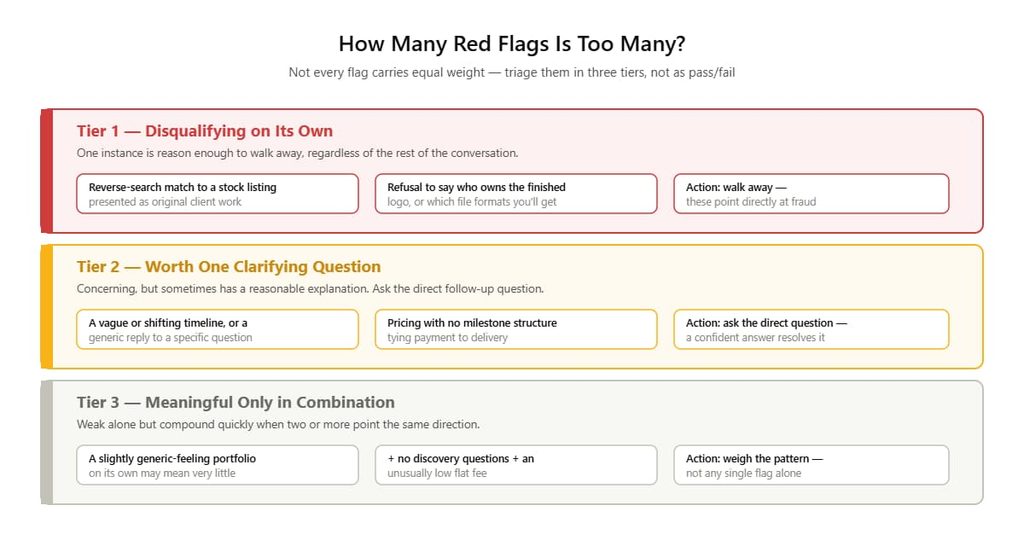
Not every red flag carries equal weight — here’s how to triage them
Not every red flag above is equally serious, and not every candidate needs to be perfect. Use this three-tier framework to decide what a given flag actually means for your hiring decision, rather than treating the list as pass/fail.
Disqualifying on its own. A small number of flags are severe enough that one instance is reason enough to walk away, regardless of how the rest of the conversation goes: a reverse-image-search match to a stock or template listing presented as original client work, refusal to specify who owns the finished logo, or refusal to say what file formats you’ll receive. These aren’t judgment calls; they point directly at fraud or an unusable deliverable.
Serious, but worth one clarifying question first. Flags like a vague timeline, a generic reply to a specific question, or pricing with no milestone structure are concerning but sometimes have a reasonable explanation, such as a freelancer between projects or a new provider still refining their process. Ask the direct follow-up question the flag raises. A confident, specific answer resolves it. A defensive or evasive answer confirms it.
Meaningful only in combination. Some individual signals are weak alone but compound quickly. A slightly generic-feeling portfolio, on its own, might just mean the designer hasn’t had many standout clients yet. That same portfolio combined with no discovery questions and an unusually low flat fee describes a resold-template operation with much higher confidence than any single flag would suggest. When two or more flags from different categories point the same direction, treat the combination as more serious than any one of them individually.
Quick-Reference Red Flag Checklist
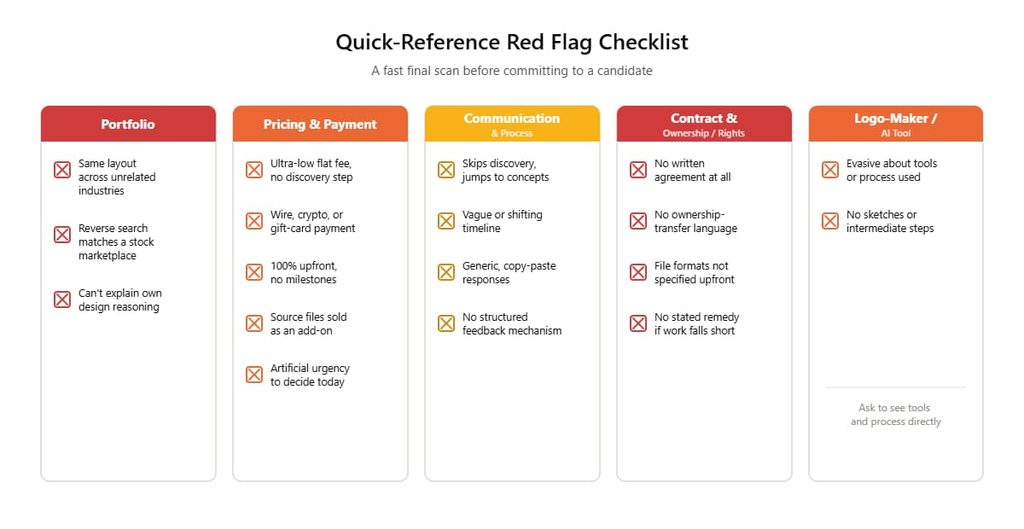
Save or print this checklist before your next candidate conversation
Use this table as a fast final scan before committing to a candidate, or during a live conversation with one.
| Category | Red Flag | Why It Matters |
|---|---|---|
| Portfolio | Every piece shares the same template layout across unrelated industries | Signals resold templates, not custom design |
| Portfolio | Image matches a stock marketplace in a reverse image search | Portfolio piece may not be original work |
| Portfolio | Designer can’t explain the reasoning behind their own past work | Suggests the work wasn’t actually theirs |
| Pricing | Ultra-low flat fee with no discovery step | Output will likely be generic or template-based |
| Pricing | “Unlimited revisions forever” with no other process structure | Bait tactic or sign of an undefined workflow |
| Pricing | 100% payment required upfront, no milestones | Removes your leverage if delivery disappoints |
| Pricing | Payment requested via wire transfer, crypto, or gift cards | Irreversible if the work never arrives |
| Pricing | Contest/spec-work platform where only the winner is paid | Attracts fast, derivative submissions over considered work |
| Pricing | Source files sold as a separate add-on | Withholds the files you actually need to use the logo |
| Pricing | Artificial urgency to decide immediately | Classic pressure tactic, not a real scarcity |
| Process | No discovery questions before “logo options” appear | Predicts a generic, off-brief result |
| Process | Vague or shifting timeline | Predicts inconsistent project management |
| Process | Generic, form-letter responses to specific questions | Signals an overloaded or inattentive provider |
| Process | No structured feedback/revision mechanism | Makes disputes about scope nearly unresolvable |
| Contract | No written agreement at all | No leverage or record if things go wrong |
| Contract | No explicit ownership/rights transfer language | You may not legally own the finished logo |
| Contract | Designer reserves rights to reuse the design | Defeats the purpose of a one-of-a-kind mark |
| Contract | File formats not specified before payment | You may receive files unusable for print or resizing |
| Contract | No stated remedy if requirements aren’t met | Full exposure if the work misses the brief |
| AI/Generator | Evasive about tools/process when asked directly | Possible resold generator output, not custom work |
If you’d rather work through these checks conversationally with a candidate before you ever see a contract, questions to ask before hiring a logo designer turns this checklist into a script.
What To Do If You Already Paid and See Red Flags
If you’re reading this mid-engagement because something already feels wrong, here’s the practical sequence.
Document everything now, not later. Save every message, every file sent, every payment receipt, and every version of the brief or scope you agreed to. If a dispute becomes necessary, dated records of what was requested and what was delivered are exactly what matters. That’s explicitly how freelance marketplace dispute reviewers evaluate cases: they weigh documented evidence, like requested-change records and specific examples of undelivered scope, over general complaints.
Request everything in writing before pushing further. Ask, in a written message, for confirmation of remaining deliverables, timeline, and file formats. A legitimate designer will respond specifically. Continued vagueness at this stage is itself a signal.
Know your platform’s process if you hired through one. Marketplaces like Upwork and Fiverr have formal dispute and refund mechanisms. Upwork’s own dispute process resource explains that funds on a fixed-price contract stay protected until you approve a milestone. You can still request a dispute specialist within 30 days of releasing payment. Cases are reviewed against documented evidence rather than subjective opinions about the work — specifically, dated records of requested changes and concrete examples of undelivered scope. That’s the practical reason the documentation step above matters even before you file anything formally.
If you hired independently rather than through a platform, your leverage depends entirely on what you have in writing. That’s precisely why the contract red flags above matter so much before you pay in the first place.
Decide between pushing for delivery and cutting losses. If the relationship is salvageable and you’re close to a usable result, a direct, documented request for specific fixes is usually the fastest path. If the pattern of red flags is severe (a fabricated portfolio, no rights transfer possible, unresponsive communication), the time cost of continuing to chase a bad engagement often exceeds the cost of starting over with a properly vetted provider.
Apply the checklist next time, before you pay anything. The entire value of this article is front-loaded: every one of these problems is far easier to prevent than to unwind.
What Good Looks Like Instead
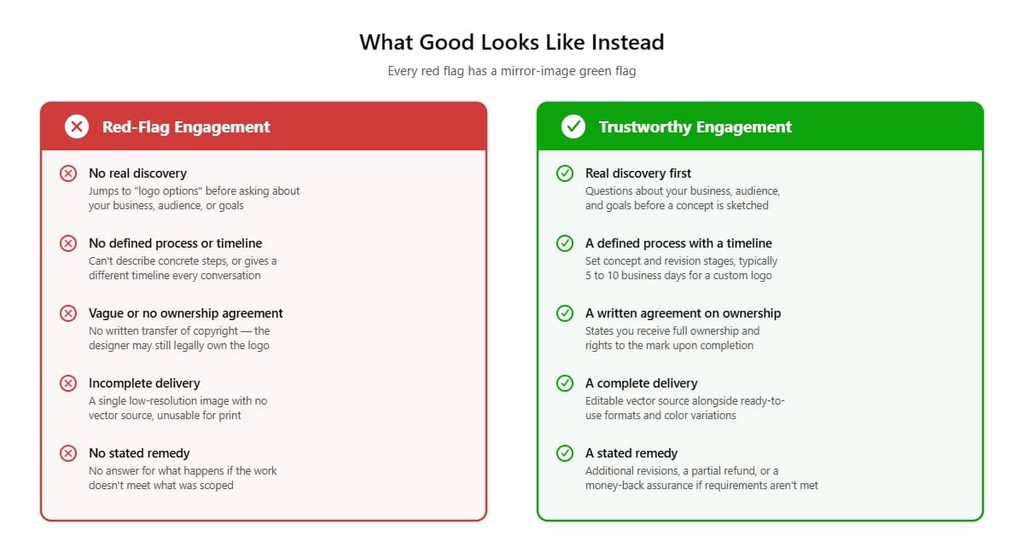
What separates a risky engagement from a properly structured one, side by side
Every red flag above has a mirror-image “green flag.” A trustworthy engagement looks like this:
- Real discovery first — questions about your business, audience, and goals before a single concept is sketched.
- A defined process with a clear timeline — a set number of concept and revision stages, typically landing somewhere in the range of 5 to 10 business days for a professional custom logo project.
- A written agreement on ownership — one that explicitly states you receive full ownership and rights to the finished mark upon completion, not a vague verbal understanding.
- A complete delivery — editable vector source files alongside ready-to-use formats, color variations, and transparent backgrounds, not a single low-resolution image you can’t actually use for print.
This is, in practical terms, the operating standard to hire against regardless of who you choose. At Graphic Designers Group, it’s structured as five explicit steps — Discovery & Briefing, Concept Development, Presentation & Feedback, Revisions, and Final Delivery — built around 100% custom design work with no templates or logo-maker software, backed by a money-back assurance if the agreed requirements aren’t met. The point isn’t that this is the only legitimate way to run a project; it’s that a defined process, a real written agreement, and complete file ownership are the baseline any designer or agency should meet before you hand over a deposit. If you’re still narrowing down between working with an individual freelancer versus a design studio, that decision carries its own risk profile worth understanding separately — see freelance designer vs. design agency. And if you want a broader vetting framework beyond red-flag avoidance, two companion pieces cover the positive selection criteria this article deliberately left out in favor of a tight focus on what to avoid: how to choose a logo designer for your small business and what to look for in a professional logo design service.
FAQ
Is a 5–25 logo always a scam?
Not necessarily a scam, but it is very unlikely to be a genuinely custom, distinctive design. At that price, expect a customized template or generator output rather than a from-scratch concept built around your specific business. It becomes a scam specifically if the seller misrepresents it as fully custom, original work, or fails to deliver the files and rights they promised.
Do I automatically own the logo once I pay for it?
Not automatically, and this is the most commonly misunderstood part of hiring a freelance designer. Under U.S. copyright law, the person who creates a work owns the copyright by default. Payment alone doesn’t transfer it. Ownership only transfers through an explicit written agreement assigning the rights to you. Always confirm this in writing before paying.
Do I need a written contract for a small, low-budget logo project?
Yes, even for a small project. The dollar amount doesn’t change the underlying legal reality that copyright ownership needs an explicit written transfer to move from the designer to you. A short written agreement or clearly stated invoice terms confirming full rights transfer upon payment is enough. It doesn’t need to be an elaborate legal document, but it does need to exist in writing.
What file formats should I actually receive?
At minimum, expect editable vector source files (AI, EPS, or SVG) plus ready-to-use raster formats (PNG, JPG, PDF), color variations, and versions with transparent backgrounds. If a provider can’t clearly list what you’ll receive before you pay, treat that as a contract red flag, not a minor detail.
Is hiring through a freelance marketplace like Fiverr or Upwork safer than hiring independently?
It offers structural protections an independent hire doesn’t: payment protection until milestones are approved, and a formal dispute process if the delivered work doesn’t match the agreed scope. It does not eliminate the portfolio, pricing, or rights risks covered in this article; those checks still apply to any candidate regardless of where you found them.
What if the designer disappears mid-project after I’ve paid a deposit?
This is exactly why milestone-based payment (rather than 100% upfront) matters, and why documentation matters from the start. If you hired through a marketplace, use its dispute or refund process, referencing your dated records of what was agreed and what was delivered. If you hired independently with no contract, your options are more limited, which is itself the strongest argument for never skipping the written-agreement step regardless of project size.
How can I tell if a portfolio piece was made with an AI logo generator rather than designed from scratch?
Ask directly what tools and process the designer used, and ask them to show intermediate concepts or variations rather than just the final result. A designer who worked manually can describe their process specifically; evasiveness on this specific question is the clearest signal. A reverse image search can also sometimes surface the same or very similar generated output used elsewhere.
Are unlimited revisions a good thing to look for?
Not by itself. A defined number of revision rounds within a structured process is a better sign than an open-ended “unlimited” promise, which is sometimes used to avoid ever finalizing a concept or to paper over the absence of any real process. What matters more than the number is whether there’s a clear structure at all.
Conclusion
Every red flag in this article shares the same underlying pattern: a gap between what’s promised and what can actually be verified. A portfolio you can check with a reverse image search. A price and payment structure you can compare against normal industry patterns. A process you can ask a candidate to describe in specific, consistent detail. A contract you can read for explicit rights-transfer language before you sign anything. None of this requires design expertise on your part — it requires knowing exactly what to check, in what order, before money changes hands. Run any candidate through this checklist, and you’ll walk into the engagement with real confidence instead of a hope that it works out.
Leave a Reply