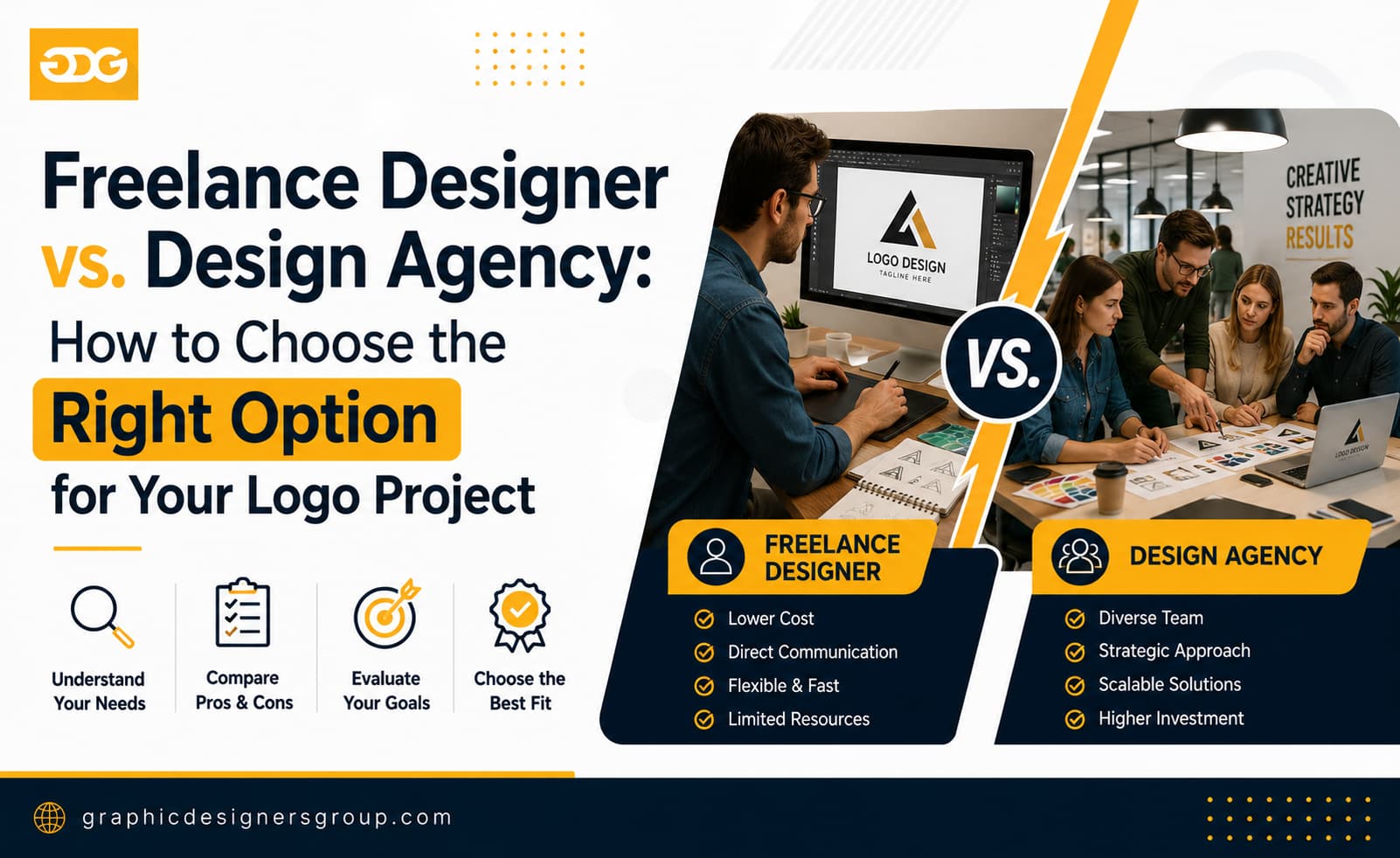
Choosing between a freelance designer and a design agency is not really a question of “who is more talented.” Both models produce excellent work and both produce disappointing work — the difference lies in cost structure, process, accountability, and how much oversight you’re willing to provide. Get the match wrong and you either overpay for infrastructure you didn’t need or underpay for reliability you did need.
This article breaks the decision down into the variables that actually matter: real price ranges, typical turnaround times, how consistent the output tends to be, what happens when something goes wrong, and which option fits which kind of project. It also covers a third path that sits between the two — a small, structured studio model — since the freelancer-or-agency framing leaves out an option a lot of small businesses end up choosing. None of this is about declaring one model universally “better.” A five-person startup and a 40-location franchise have different logo problems, and the right sourcing model follows from the problem, not the other way around.
Quick answer: Freelancers typically cost
2,500 and deliver in 3–10 business days, best for a single, narrow-scope logo on a tight budget where you can manage the process yourself. Agencies typically cost
10,000+ and take 1–4 weeks, best for complex, multi-touchpoint rebrands with real budget and a need for built-in redundancy. A structured small studio sits between the two — project-based pricing, a defined process, and a 5–10 business day turnaround — and fits the large group of small businesses whose actual need is “one excellent custom logo, done properly,” not either extreme. The sections below explain exactly why, with sourced numbers for each claim.
What “Freelance Designer” and “Design Agency” Actually Mean
The two terms get used loosely, so it helps to define them by structure rather than by size alone.
A freelance designer is one individual, working independently, who takes on your project directly. There’s no account manager, no creative director reviewing their work, and no second designer as backup. You’re hiring a specific person’s skill, taste, and availability. Freelancers are found on marketplaces (Upwork, Fiverr, Dribbble), through referrals, or via their own portfolio sites, and quality varies enormously — the same platform that has designers charging
2,000, with correspondingly different levels of strategic thinking behind the work.
A design agency is a company with multiple people involved in your project: typically a project or account manager, one or more designers, and often a creative director who reviews output before it reaches you. The agency absorbs overhead — office costs, software licenses, account management, quality control — into its pricing. In exchange, you get built-in redundancy: if one person is out sick, someone else can usually keep the project moving.
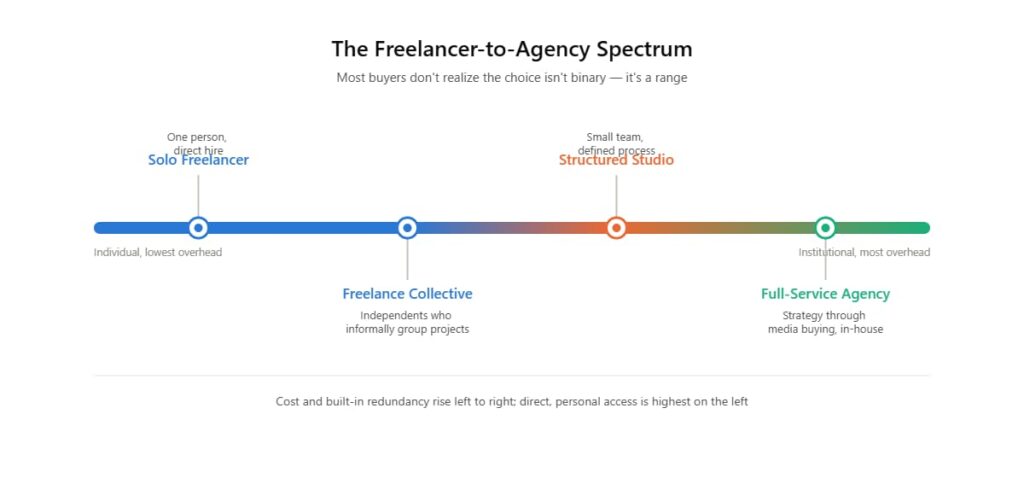
Between these two poles sits a spectrum most buyers don’t think about: solo freelancers, freelance collectives who informally group projects, boutique studios with a small core team and a defined process, and full-service agencies handling everything from strategy to media buying. A boutique studio — a small team large enough to have a repeatable process and quality review, but without agency-scale overhead — is worth knowing about before you assume your only choices are “cheap individual” or “expensive firm.” For an independent studio with over a decade in custom logo design, this middle position is the norm rather than the exception, and it’s covered in more detail later in this article.
Two adjacent models sit outside this comparison but are worth naming so you know what you’re deliberately excluding. Crowdsourced contest platforms, 99designs being the best-known, let you post a brief and collect dozens of competing concepts from different designers before paying only the one you pick — useful for seeing a wide range of directions fast, but you’re paying for volume from strangers, not a vetted relationship, and most entrants you’ll never work with again. AI logo generators (Looka, Tailor Brands, Canva’s logo maker, and similar tools) assemble a mark in minutes from a library of templates, shapes, and fonts rather than building one from scratch for your brand specifically, which makes them fast and inexpensive but also means the same underlying template can surface in a competitor’s result. Both serve a real, narrow need — a contest for volume, an AI tool for a placeholder before real budget exists — but neither replaces the custom, one-to-one working relationship this comparison is built around, which is why freelancers, agencies, and structured studios are the three models examined here.
Cost Comparison: What You Actually Pay
Price is usually the first filter, so it deserves real numbers rather than “it depends.”
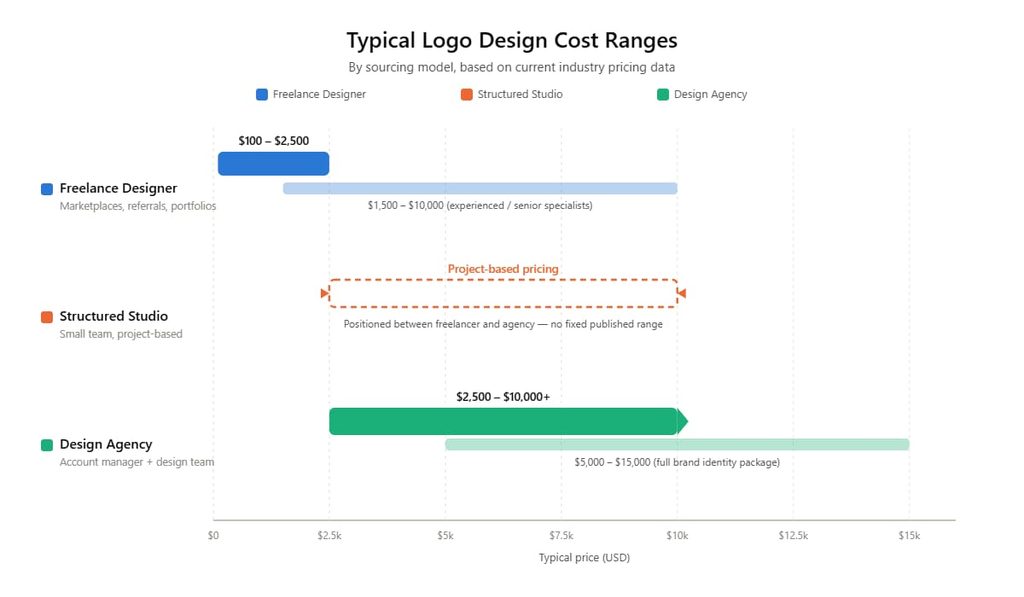
Freelance designers span an unusually wide range because skill, platform, and geography all move the price independently. Fiverr’s own guide puts remote freelance logo designers at
2,200 and narrows typical freelance logo pricing on its platform to
2,500, with entry-level sellers starting around
35 for the most basic packages and vetted, top-rated professionals charging
250 and up per project (Fiverr, “How Much Does a Logo Design Cost?”).
Designhill’s separate pricing research puts the general freelance range at
5,000. It breaks that down further by experience tier: beginner freelancers typically charge
1,000, while experienced freelancers charge
10,000 for more strategic, brand-level work (Designhill, “How much do freelancers charge for a logo design”). Hourly freelance rates on major platforms run from roughly
200, depending on the designer’s track record and where they’re listed.
100–$175/hour, with project totals often growing 30–50% past the original quote due to scope creep. Both are worth pricing in before comparing a freelancer’s initial quote to an agency’s fixed-scope proposal.
Agencies commonly ask for a deposit before work begins, sometimes a substantial share of the project fee. Confirm the exact percentage and refund terms in writing before signing rather than assuming a standard figure.
It’s also worth knowing where most buyers actually land: Fiverr’s research found that **65% of businesses will pay only up to
1,000 (Fiverr, “How Much Does a Logo Design Cost?”) — precisely why the freelance middle-tier and boutique-studio segment exists to serve the large group of businesses who want more than a
Headline price ranges hide the details that actually determine what you pay. Before comparing any two quotes side by side, get a direct answer on each of these:
- How many concepts are included? Some freelance quotes cover a single concept with one revision; each additional round is billed separately, which can erase the initial savings fast.
- Is the quote for a logo alone, or a full identity system? A
500 freelance quote aren’t actually comparable unless you know exactly what each includes.
- What’s the revision policy after the included rounds? Agency overage rates of
250/hour (Kapa99) can turn a moderate initial quote into an expensive one if the first concepts miss the mark.
- Is a deposit required, and how much? Agencies commonly ask for a deposit before starting, sometimes a substantial share of the fee; freelancers vary widely, and an unusually large upfront ask from either is worth questioning.
Reviewing what should be included in a logo design package before comparing quotes prevents the apples-to-oranges mistake described above, and if the scope is really a full identity system rather than a single mark, it’s worth checking current brand identity pricing for small businesses instead of a logo-only figure. For a deeper breakdown of what drives price within any of these tiers, see a full breakdown of logo design pricing — it also explains why two quotes with an identical dollar figure can represent very different amounts of actual work.
Process and Speed: What the Timeline Actually Looks Like
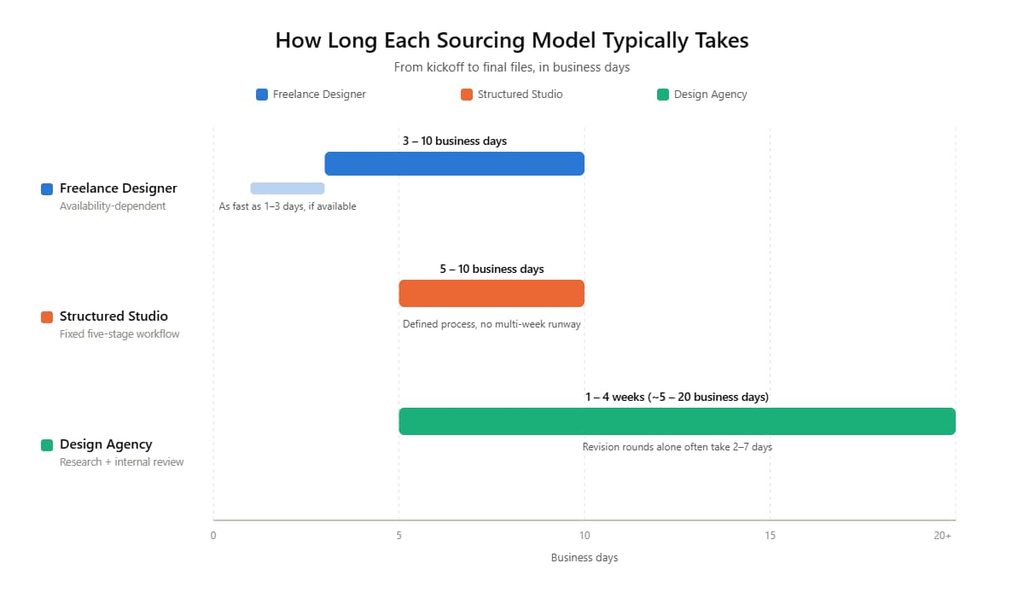
Cost and speed are related but not interchangeable — a fast freelancer and a slow one exist at the same price point, and the same is true of agencies.
Freelancers typically move faster at the start of a project simply because there’s one decision-maker and no internal handoffs. Independent research on logo design timelines puts freelance turnaround at roughly 3–10 business days, depending on the designer’s current workload and how quickly the client responds to concept reviews (Omocracy, “How Long Does It Take to Design a Logo?”). A separate comparison of design sourcing models found freelancers could turn around initial concepts in as little as 1–3 days when available — the caveat being availability, since a freelancer juggling several clients at once may push your project back with little warning (Kapa99). The tradeoff for speed is that you, the client, become the project manager: tracking revisions, chasing responses, and catching inconsistencies yourself, since there’s no one else on the freelancer’s side doing that for you.
Agencies generally run a longer, more structured timeline. The same turnaround research puts professional agency timelines at 1–4 weeks, covering research, internal briefing, concept development, and multiple structured review phases before anything reaches the client, with revision phases alone often taking 2–7 days depending on feedback speed (Omocracy). This is slower, but the structure exists for a reason: a documented process reduces the odds of the project stalling because one person got busy, and it typically builds in strategic groundwork — audience research, competitor review, positioning — that a fast freelance turnaround usually skips.
The stage that determines whether either timeline holds is the first one: discovery. A rushed 15-minute intake call almost always produces concepts that miss the brief, which then costs more revision rounds than a slower, more deliberate discovery stage would have — so a designer or studio that pushes back and asks detailed questions before starting concepts is usually saving you time overall, not adding to the timeline.
A structured studio model can capture some of both advantages: a defined process without the multi-week agency runway. As a reference point, a small custom-logo studio following a fixed five-stage sequence (discovery and briefing, concept development, presentation and feedback, revisions, and final delivery) can typically complete a project in 5–10 business days. That lands between the fastest unstructured freelance turnaround and the slower end of agency timelines, while still including the strategic groundwork a rushed one-day freelance turnaround skips entirely. Whatever route you choose, going in with a written brief shortens the timeline regardless of who you hire; how to write a logo design brief covers exactly what to include so the first round of concepts is closer to usable. For a broader look at what drives timeline variation across project types, see how long professional logo design actually takes.
Quality, Consistency, and Creative Range
Price and speed are measurable. Quality is not. That’s exactly why it gets the least honest treatment in most comparisons, and why it’s worth being specific about what actually drives it rather than which label is on the invoice.
With a freelancer, you are evaluating one person’s judgment, full stop. There’s no second set of eyes and no institutional standard behind the work, so quality has the widest variance of any sourcing option: the same platform, the same price bracket, can produce a genuinely excellent mark or a barely competent one, and nothing about the price tag tells you which you’re getting. That’s exactly why portfolio review carries more weight when hiring a freelancer than when hiring an agency. An agency’s internal review process catches some inconsistency before it reaches you, but with a freelancer, what you see in the portfolio is close to what you’ll get. It also caps creative range in a specific way: a designer who’s built a portfolio around minimalist wordmarks is rarely your best choice for an illustrative emblem logo, because that isn’t the muscle they’ve trained.
Agencies trade that individual variance for process-driven consistency. Internal review stages, brand guidelines, and creative-director sign-off mean the floor sits more consistently higher, so a genuinely bad deliverable is less likely. The tradeoff is a lower ceiling on any single project, since output gets smoothed by committee-style review rather than driven by one person’s distinct point of view. Range tends to be broader across styles (wordmark, lettermark, pictorial, abstract, combination, emblem), because agencies can assign different specialists to different jobs rather than relying on one person’s trained instincts.
A studio built specifically around 100% custom design work takes a third position: no templates, no logo-generator software, every mark built from scratch for the brand in front of them. That sits closer to the agency end of this spectrum on consistency (there’s a defined process and revision structure) while keeping a tighter, more hands-on creative relationship than a large agency typically offers. This matters because a weak or generic logo carries real business cost: inconsistent brand impressions, low differentiation from competitors, and the need for a costly redesign sooner than expected. Quality consistency isn’t a cosmetic concern here. It’s a cost-avoidance one.
Risk and Reliability: What Can Actually Go Wrong
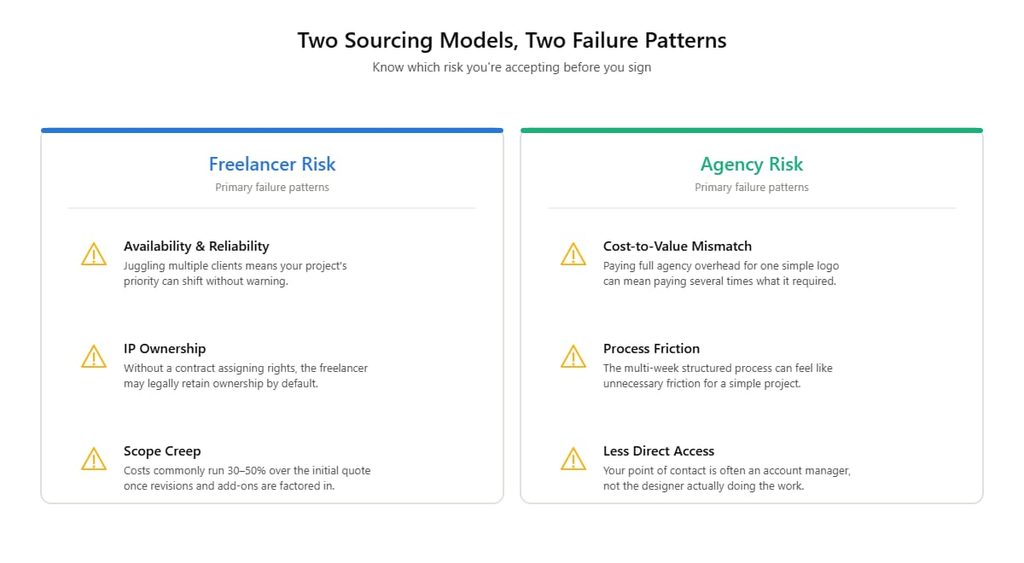
Every sourcing model has a distinct failure mode. Knowing it in advance — and building one specific contract term around it — is more useful than a generic “do your research” warning.
Freelancer risk clusters around three well-documented patterns, per Upwork’s own guidance on hiring risk:
- Availability and reliability. Freelancers juggle multiple clients simultaneously, so your project’s priority can shift without warning, and communication that takes minutes in an office can take hours when a freelancer is managing several accounts on their own schedule (Upwork, “The Risks of Hiring Freelancers”).
- Intellectual property ownership. Without a contract that explicitly assigns rights to your business, the freelancer who created the work may legally retain ownership of it by default — a serious problem if you later want to trademark the logo or the relationship ends on bad terms.
- Scope creep. Kapa99’s research found freelance project costs commonly run 30–50% over the initial quote once revisions and add-ons are factored in.
The practical mitigation for the first risk is structural, not just cautionary: pay in milestones tied to specific deliverables (concept approval, revision round, final files) rather than the full fee upfront, so a stalled project costs you incomplete work instead of a lost payment.
Agency risk runs in a different direction. Reputable agencies have formal contracts and won’t vanish mid-project, so the primary risk isn’t disappearance or IP disputes. It’s cost-to-value mismatch on simple projects. Paying agency overhead (account management, internal review layers, office costs) for a single, straightforward logo can mean paying several times what the project actually required, and the multi-week structured process that benefits a complex rebrand can feel like unnecessary friction for a business that just needs a clean, professional mark. Agencies can also feel less personal: your point of contact is often an account manager rather than the designer actually doing the work, which can slow down nuanced creative feedback.
A studio model addresses part of both risk profiles by design: a defined five-step process with a specific step for revisions reduces the freelancer-side risk of an undefined, open-ended relationship, while a smaller team structure and project-based (not overhead-heavy) pricing avoids the agency-side risk of paying for scale you don’t need. A money-back assurance tied to agreed requirements — the kind of guarantee more common among structured independent studios than solo freelancers — is also worth asking about directly, since it shifts risk back toward the provider rather than leaving it entirely with you. Regardless of which model you choose, it’s worth reading through common red flags before hiring any logo designer so you can spot a bad fit before signing anything, not after paying a deposit.
Freelancer vs. Agency vs. Structured Studio: Full Comparison
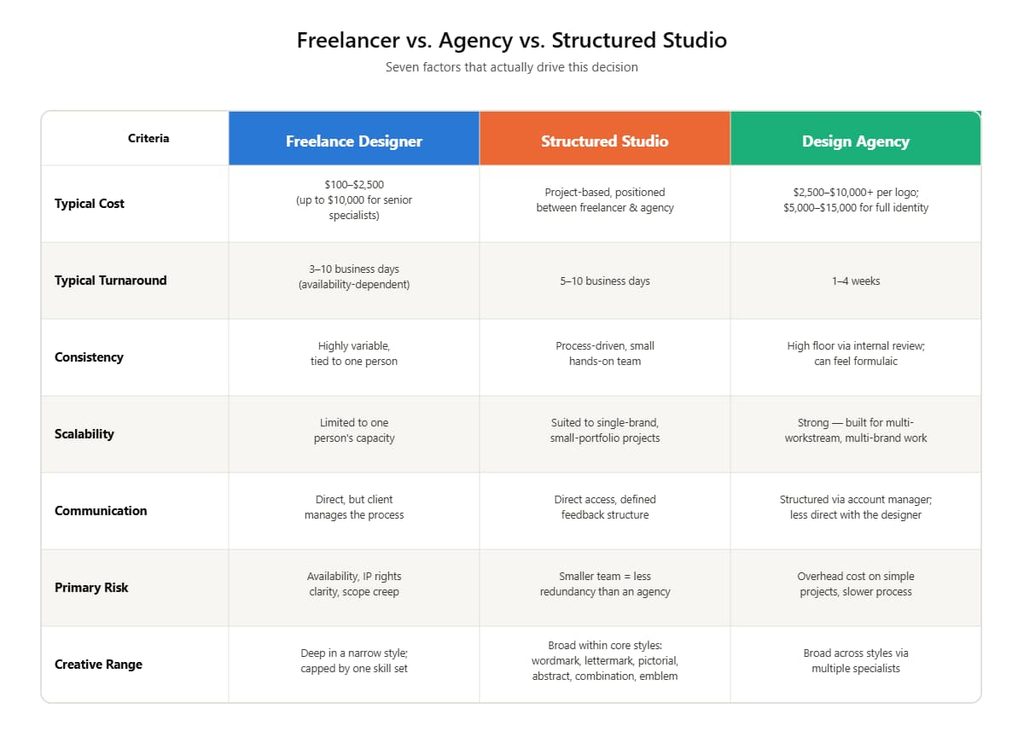
| Criteria | Freelance Designer | Design Agency | Structured Small Studio |
|---|---|---|---|
| Typical cost |
2,500 (up to $10,000 for senior specialists) |
10,000+ per logo; 15,000 for full identity | Project-based, positioned between marketplace freelancers and agency retainers |
| Typical turnaround | 3–10 business days (availability-dependent) | 1–4 weeks | 5–10 business days |
| Consistency | Highly variable, tied to one person | High floor via internal review; can feel formulaic | Process-driven consistency with a small, hands-on team |
| Scalability | Limited to one person’s capacity | Strong — built for multi-workstream, multi-brand work | Suited to single-brand and small-portfolio projects |
| Communication | Direct, but client manages the process | Structured, via account manager; less direct with the designer | Direct access with a defined feedback structure |
| Primary risk | Availability, IP rights clarity, scope creep | Overhead cost on simple projects, slower process | Smaller team means less redundancy than a large agency |
| Creative range | Deep in a narrow style; capped by one skill set | Broad across styles and disciplines via multiple specialists | Broad within core logo styles (wordmark, lettermark, pictorial, abstract, combination, emblem) |
Which One Fits Your Situation
A framework is only useful once it’s applied to an actual project. Here’s how the decision typically plays out across common small-business scenarios.
Choose a freelancer if you have a genuinely tight, defined budget under roughly
1,000, the project is a single, narrow deliverable (a logo only, no supporting brand system), you’re comfortable managing the back-and-forth yourself, and you’ve already vetted the individual’s portfolio carefully for the specific style you want. This works especially well for pre-revenue founders testing an idea who need a professional-enough mark to launch, not a full brand system yet.
Choose a design agency if the project is genuinely complex — a full rebrand across multiple touchpoints, a multi-brand portfolio that needs coordinated identity systems, or a project where strategic positioning work (audience research, competitive analysis, naming) is as important as the visual design itself — and your budget realistically supports $5,000 and up. Agencies also make sense when you need one vendor to handle logo, brand guidelines, packaging, and digital assets under a single coordinated process, and when internal redundancy (a backup if your main contact is unavailable) matters more than direct designer access.
Choose a structured small studio if you want more reliability and process than a solo freelancer typically offers — a defined discovery-to-delivery sequence, dedicated revision rounds, a clear rights-transfer agreement — without paying agency-level overhead for a project that’s fundamentally “we need one excellent, custom logo, not a full agency retainer.” This is the common middle case: an established small business past the pre-revenue stage, a restaurant or professional-services firm that needs a mark that photographs well across signage and packaging, or a growing company doing its first real rebrand rather than a from-scratch startup logo.
A few situations deserve a specific note. If you’re not sure whether the project is actually a logo job or a bigger scope, it’s worth resolving whether you need a standalone logo or a complete brand identity before requesting quotes from anyone — this single decision changes which sourcing model makes financial sense. And if the driver of this search is an existing logo that’s underperforming rather than a brand-new company, the more relevant question is when a rebrand is actually warranted versus refreshed in place, since that changes both scope and the sourcing decision.
The Middle Path: What a Structured Small Studio Actually Offers
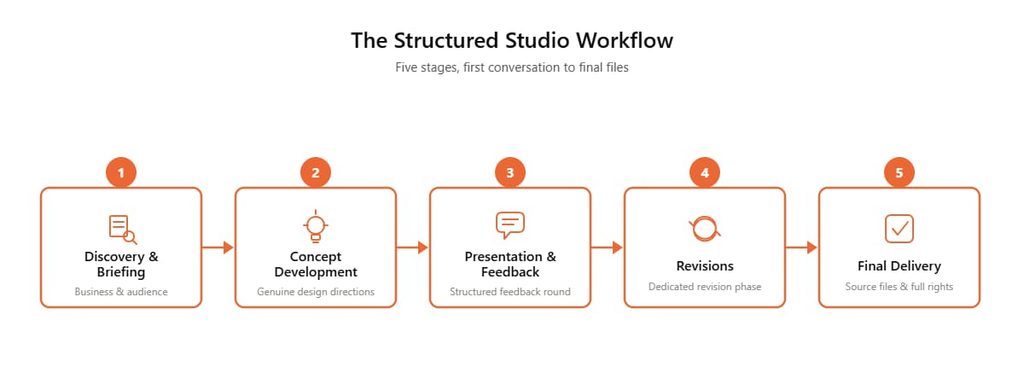
The freelancer-versus-agency framing implies only two options, but a meaningful segment of small businesses are better served by something in between: a small team with a repeatable process, custom (not template-based) output, and pricing that reflects a lean operation rather than agency-scale overhead.
Concretely, this looks like a defined five-stage workflow — discovery and briefing to understand the business and audience, concept development producing genuine design directions rather than a single guess, a structured presentation and feedback round, a dedicated revision phase, and final delivery — run by a small team rather than one person working alone. It also typically includes the kind of deliverable completeness that freelance quotes sometimes strip out to hit a lower price: source files across formats (AI, EPS, PDF, PNG, JPG, SVG), color variations, transparent backgrounds, and social-ready versions, with full ownership and usage rights transferred to the client rather than left ambiguous. Graphic Designers Group, an independent studio with 11+ years working across professional services, restaurants, tech, real estate, and other small-business categories, operates on exactly this model — every logo built from scratch across the standard style categories (wordmark, lettermark, pictorial, abstract, combination, and emblem marks), with a 5–10 business day turnaround and a money-back assurance if agreed requirements aren’t met.
The honest way to frame this option: it won’t out-scale a full-service agency handling a multi-brand enterprise rollout, and it won’t undercut the cheapest marketplace freelancer on raw price. What it offers is a specific tradeoff — agency-level process discipline and deliverable completeness, at independent-studio pricing — for the large group of small businesses whose project is genuinely “one excellent custom logo, done properly” rather than either extreme.
How to Evaluate Either Option Before You Hire
Whichever model you lean toward, the vetting steps are largely the same, because the failure modes — bad fit, unclear rights, scope disputes — show up in both freelance and agency relationships.
Start with the portfolio, but look past whether individual logos are attractive. Evaluating a designer’s portfolio properly means checking for range across industries and styles, evidence of strategic thinking (not just decoration), and — where possible — context on the actual business results the work supported. A short list of pointed questions to ask before signing anything covers the interview side of vetting in more depth, and it’s worth running through a broader checklist for evaluating any professional logo design service no matter which type of vendor is on the other side of the table.
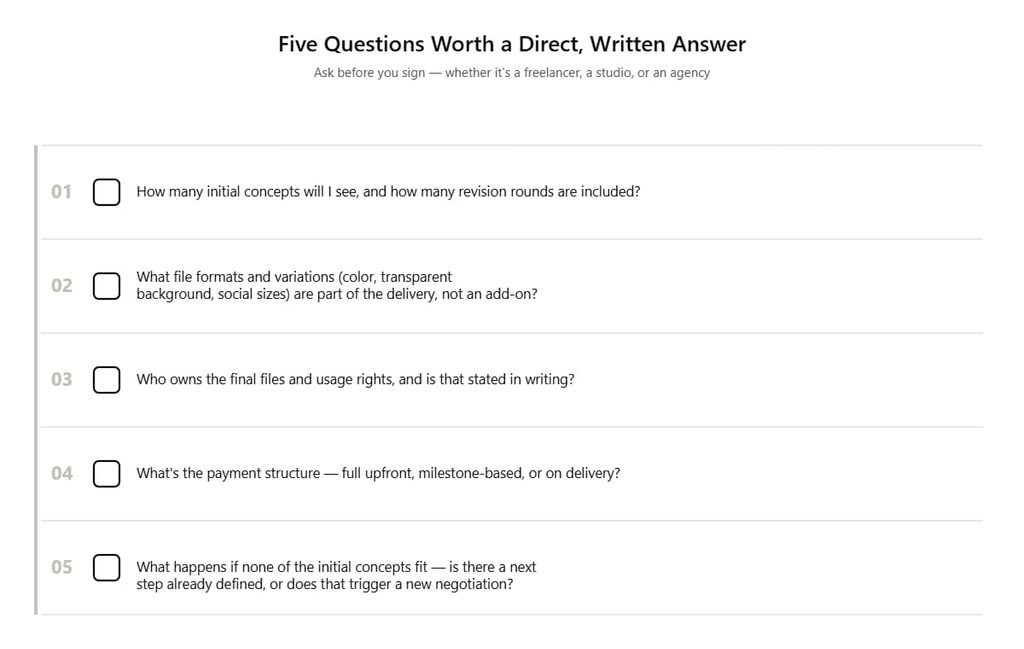
Once the portfolio and reputation check out, confirm the process itself in writing. The same five questions cover nearly every dispute that comes up later, applied equally to a freelancer, a studio, or an agency:
- How many initial concepts will I see, and how many revision rounds are included?
- What file formats and variations (color, transparent background, social sizes) are part of the delivery, not an add-on?
- Who owns the final files and usage rights, and is that stated in writing?
- What’s the payment structure — full upfront, milestone-based, or on delivery?
- What happens if none of the initial concepts fit — is there a next step already defined, or does that trigger a new negotiation?
Finally, treat price as one input, not the deciding one. The tradeoffs of choosing the cheapest available option are worth understanding before you commit to the lowest bid, since a logo that needs to be redone in a year costs more in total than a slightly higher upfront investment that gets it right the first time. And if the whole comparison feels overwhelming, a structured approach to choosing a designer for a small business walks through the decision in more depth than fits in this comparison alone. Whoever you choose, put your requirements in writing first — a clear brief is the single biggest predictor of a smooth project, from a solo designer to a full agency team.
Frequently Asked Questions
Is it cheaper to hire a freelancer or a design agency for a logo?
Freelancers are cheaper in nearly every case — typical freelance logo pricing runs roughly
2,500, while agency logo pricing typically starts around
3,000–
1,500–$10,000, closer to agency-level pricing, but the entry point for freelance work is consistently lower.
Can a freelancer handle a full brand identity, not just a logo?
Some can, but it depends heavily on the individual’s range — a full identity system (logo, color palette, typography, brand guidelines, collateral) requires broader skills than a single logo, and many freelancers specialize narrowly. Agencies and structured studios are generally built to handle that broader scope as a matter of course; with a freelancer, ask directly whether they’ve delivered full identity systems before, not just individual logos.
How do I know if a freelance designer is legitimate before paying anything?
Check for a real, verifiable portfolio (not just polished mockups with no visible client context), ask for a written agreement that explicitly assigns IP and usage rights to you, request references or examples of completed, delivered projects, and be cautious of anyone unwilling to put revision terms and delivery timelines in writing before you pay a deposit.
Do design agencies always take longer than freelancers?
Generally yes, for the initial turnaround — agencies typically run 1–4 weeks against a freelancer’s 3–10 business days — because the process includes more structured research and internal review stages. That said, a freelancer’s speed advantage depends entirely on their current availability; an overbooked freelancer can end up slower than a well-organized small studio or agency.
What happens if a freelance designer stops responding mid-project?
This is one of the most cited freelance-specific risks, since there’s no backup team member to take over. Protect against it contractually before starting: agree on milestone payments rather than paying the full fee upfront, confirm what happens to partial work if the project stalls, and check recent reviews or references for responsiveness patterns before hiring.
Should a very early-stage startup with a tight budget use a freelancer or an agency?
For a first logo on a limited budget, a freelancer or a small structured studio is typically the better fit than a full agency — the project is usually narrow in scope (one logo, not a multi-touchpoint identity system), and agency overhead pricing is hard to justify at that stage. A full-service agency becomes more relevant once the business has scaled and needs coordinated, multi-channel brand work.
Do I own the rights to my logo either way?
Not automatically. With freelancers especially, ownership can default to the creator unless a contract explicitly transfers it to you — this is a documented, common gap. Reputable agencies and studios typically build full rights transfer into their standard terms, but you should confirm this in writing regardless of who you hire, before the project starts, not after.
Is a small structured studio actually different from just a solo freelancer with a nice website?
The meaningful difference is process and redundancy, not marketing polish. A structured studio runs a defined, repeatable workflow (discovery, concepts, feedback, revisions, delivery) with more than one person able to move a project forward, and typically formalizes deliverables, rights transfer, and guarantees in ways that vary widely among individual freelancers. A well-designed website doesn’t tell you which one you’re dealing with — the process and contract terms do.
The Decision, Simplified
Every scenario in this article reduces to the same underlying test, worth naming so you can apply it beyond logos: match the sourcing model’s overhead to the project’s actual complexity, not to its budget alone. A freelancer’s low overhead is wasted risk-tolerance on a project too complex for one person to carry; an agency’s high overhead is wasted cost on a project too simple to need a team. Most first-time and second-time logo projects for small businesses land in the middle of that scale — complex enough to need a real process, not so complex that they need agency-scale infrastructure — which is precisely the segment a structured small studio is built to serve.
Once you know where your project actually sits on that scale, the rest of this article becomes a checklist rather than a debate: confirm the price against real ranges, confirm the timeline against real turnaround data, get the revision and rights terms in writing, and evaluate the portfolio for range rather than polish. That sequence works whether you end up hiring one person, a five-person studio, or a full agency team — because it tests the vendor, not the label on their business card.
Leave a Reply